

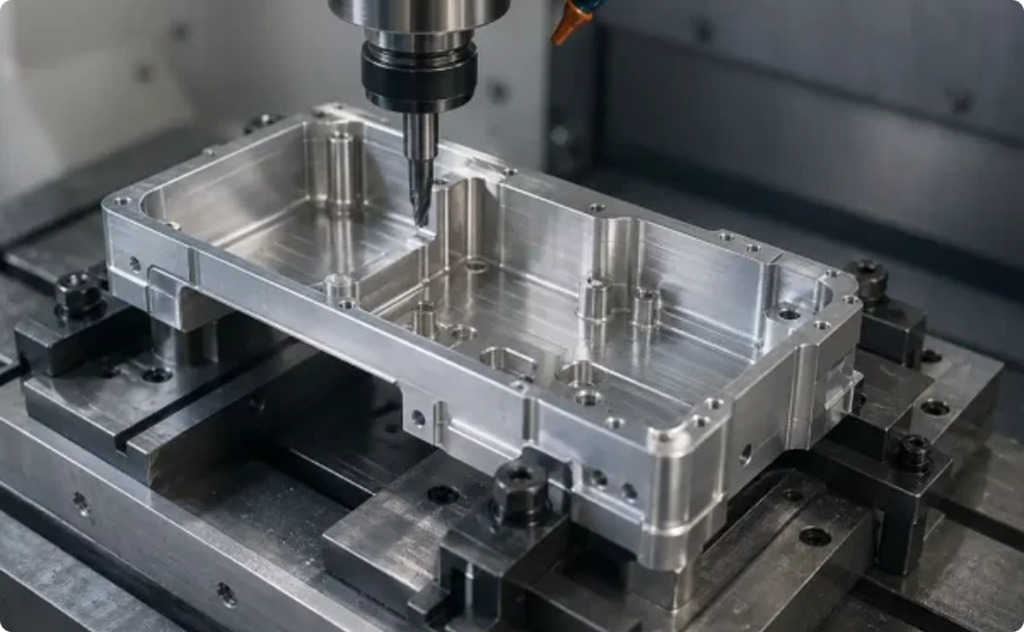
Learn metal 3D printing essentials: key technologies, material options, costs, design tips, post-processing methods, and how to choose the right service provider for your project.
Introduction
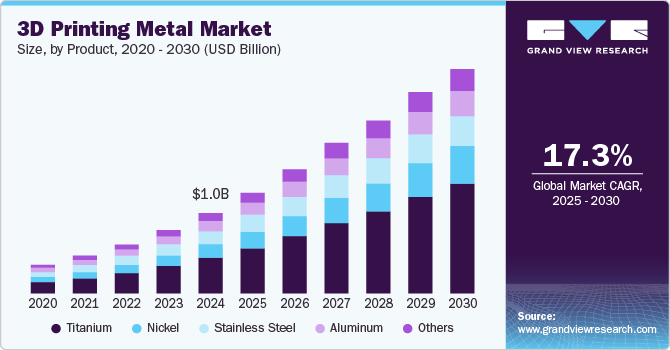
Source: Grand View Research
According to Grand View Research, the global 3D printing metal market is surging — valued at $1.0 billion in 2024 and projected to grow at 17.3% annually through 2030. This explosive growth stems from rapid innovations in printing technologies and the shift toward digital-first manufacturing.
So, what are the key aspects of Metal 3D Printing?
In this comprehensive guide, we break down everything you need to know:
-
Basics & Showdown: What metal 3D printing is and how it differs from traditional manufacturing methods.
-
Technologies & Materials: How core technologies (like SLM and Binder Jetting) work, how they compare, and how to select the right materials for your application.
-
Costs, Design & Post-Processing: How to estimate costs, optimize your CAD designs, and select the right post-processing options.
-
Service Selection & Case Studies: Practical guidance on choosing the right service provider, along with real-world Unionfab case studies.
What is Metal 3D Printing?
Metal 3D printing, also known as metal additive manufacturing (AM), is a production method that builds fully dense metal parts layer by layer directly from a digital 3D model.
Unlike traditional subtractive methods that remove material from a solid block, metal 3D printing selectively melts, binds, or deposits metal powder or wire only where material is needed. The result is a near-net-shape component that requires minimal material waste and enables geometries that were previously impossible to manufacture.
Today, metal 3D printing is widely used across industries such as aerospace, automotive, medical devices, energy, and tooling. From lightweight lattice structures to conformal cooling channels inside molds, additive manufacturing allows engineers to rethink part design rather than simply replicate conventional geometries.
Metal 3D Printing Overview
With so many technologies, alloys, and finishing methods available, many people exploring metal 3D printing encounter a wide range of unfamiliar terms, such as Powder Bed Fusion, 316L stainless steel, Design for Additive Manufacturing (DfAM), heat treatment, and surface finishing.
This often raises a question: how are these concepts related, and where do they fit within the broader framework of metal additive manufacturing?
To simplify this, it helps to think of metal 3D printing as a mathematical formula.
At its core, every successful metal AM application is a combination of six fundamental variables: industry, use case, design (DfAM), technologies, materials, and post-processing.
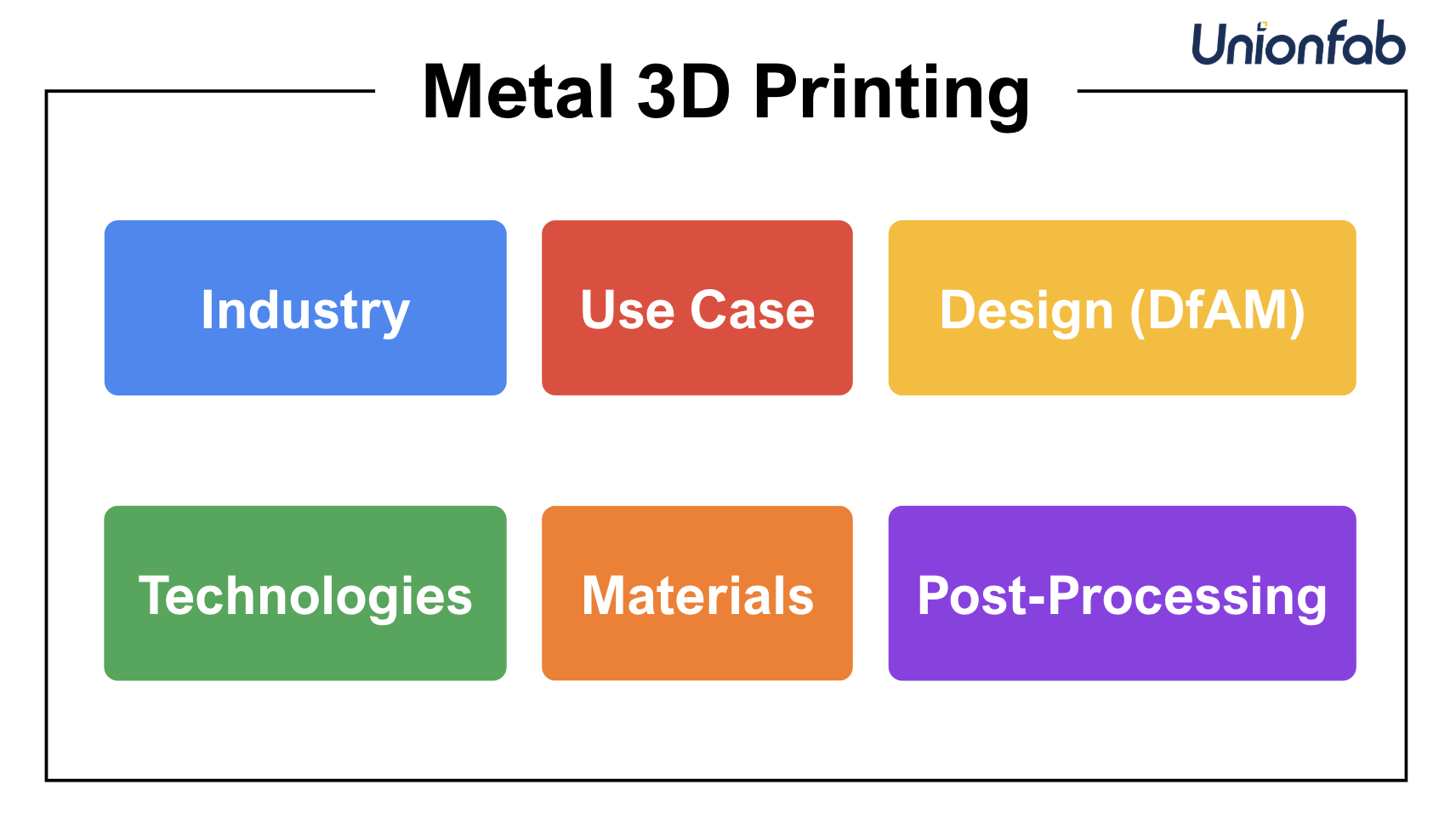
How the Equation Works in the Real World
By defining and combining these variables, you can construct the exact solution for any specific project.
For example, suppose you need to manufacture a high-performance orthopedic implant. The “equation” would look like this:
[Industry: Medical] + [Use Case: End-Use Part] + [DfAM: Porous Lattice Structure] + [Technology: SLM/EBM] + [Material: Titanium Ti6Al4V] + [Post-Processing: Sterilization & Machining] = A biocompatible, custom-fit hip implant.
To visualize this framework, refer to the mind map below, which breaks down the six primary categories and their subcategories.
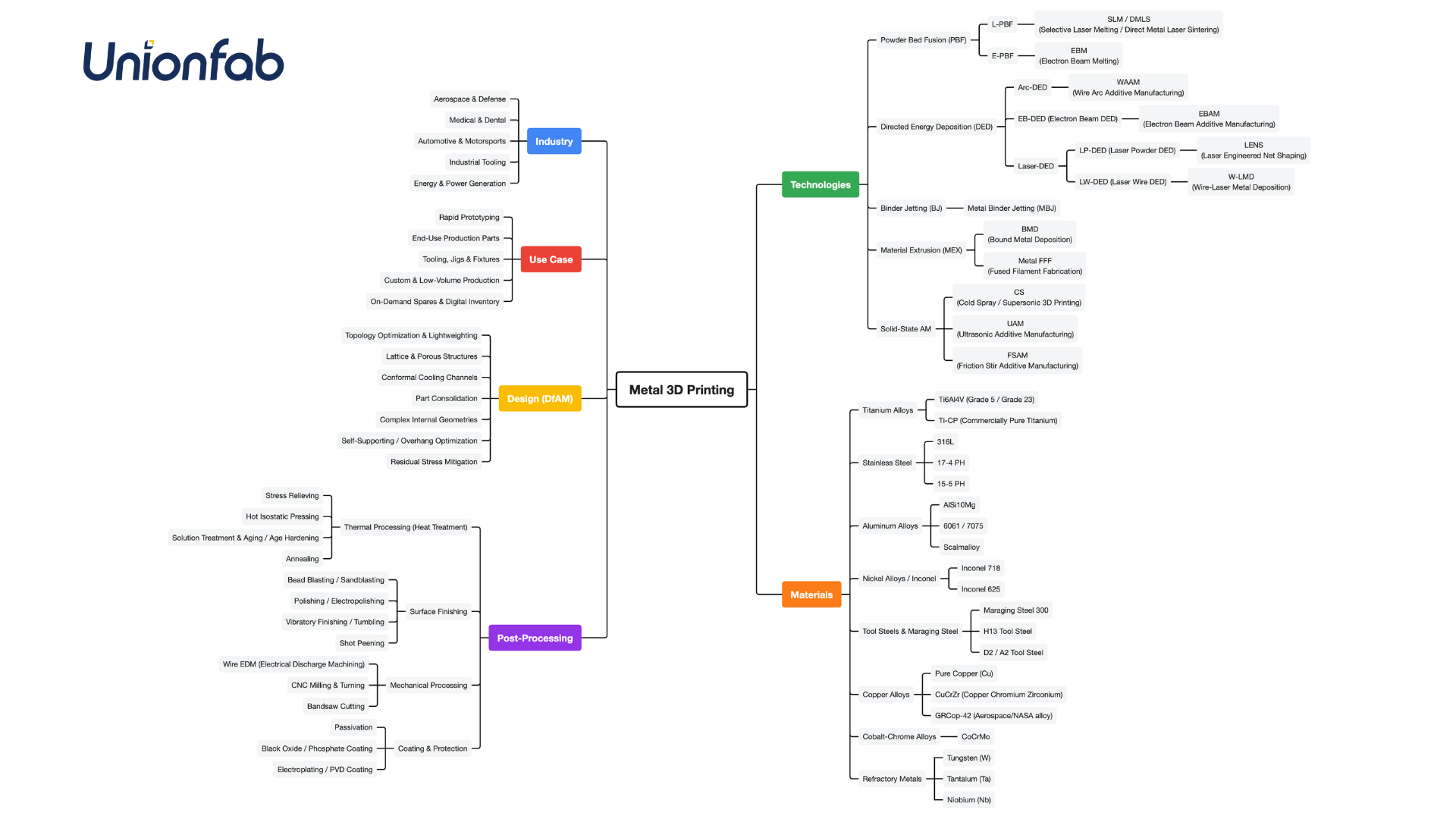
The mind map above visualizes how the six key variables of metal 3D printing are organized. Each primary category expands into more specific topics. For instance, metal 3d printing technologies include processes such as PBF, DED, BJ, and MEX, while materials cover common alloy families like titanium, stainless steel, aluminum, and nickel alloys. Post-processing further includes heat treatment, surface finishing, and machining steps required to achieve the final part performance.
This structured view helps clarify how different concepts in metal additive manufacturing relate to one another.
Metal 3D Printing vs. Traditional Manufacturing
To better understand metal 3D printing, it is useful to compare it with conventional methods such as CNC machining and casting.
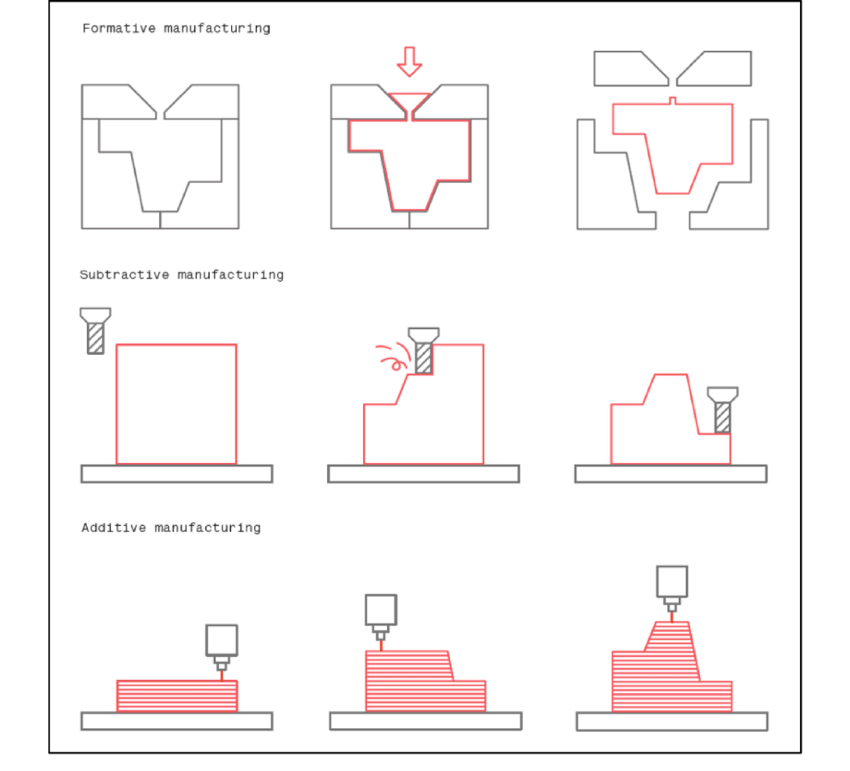
Source: researchgate.net
As shown above, the three methods differ fundamentally in how material is formed:
-
Formative Manufacturing (Casting): Molten metal is poured into a mold cavity and solidifies into shape.
-
Subtractive Manufacturing (CNC Machining): Production begins with a solid block, and cutting tools remove material to achieve the final geometry.
-
Additive Manufacturing (Metal 3D Printing): Components are built layer by layer directly from a digital model.
If you’re deciding between metal 3D printing, CNC machining, and casting, the following guides explain their key differences and help you choose the right manufacturing method for your project.
-
Metal 3D Printing vs. CNC Machining: Competition or Complementarity
-
3D Printing vs. CNC vs. Vacuum Casting: The Ultimate Comparison
For a quick overview, the table below summarizes the key differences between the three manufacturing methods.
|
Aspect |
Metal 3D Printing (Additive) |
CNC Machining (Subtractive) |
Casting (Formative) |
|---|---|---|---|
|
Geometry Complexity |
Highest: Excels at intricate internal channels, lattices, and organic forms |
Moderate: Limited by tool access; complex interiors require multiple setups |
Moderate to High: Mold-dependent; undercuts require complex cores |
|
Production Speed |
No tooling delay (fast setup); slower per-part printing time |
Fast for small to medium batches |
Slowest setup (mold creation); fastest per-part speed at high volumes |
|
Material Waste |
Minimal: Powder is largely recyclable |
High: Can exceed 70–90% waste for highly complex parts |
Moderate: Gates/runners waste, though mostly recyclable |
|
Material Selection |
Growing range of specific high-performance alloys (Titanium, Inconel, Steels, Aluminum) |
Very broad range of virtually all machinable metals |
Broad range (especially specific cast alloys) |
|
Surface Finish |
Rougher; typically requires post-processing or CNC touch-ups |
Excellent: High precision and smooth finish right off the machine |
Moderate; secondary machining is often required |
|
Upfront Cost |
Zero tooling cost |
Low to moderate setup cost |
Highest tooling/mold cost |
|
Best Production Volume |
Prototypes to Low/Medium volume |
Medium volume |
High to Mass volume |
Metal 3D Printing Processes & Technologies
What metal 3D printing technologies are available today, which have reached industrial adoption, and which remain under development? And among the established methods, what distinguishes them from one another? Let’s take a closer look.
Evolution of Metal 3D Printing Technologies
According to the ISO/ASTM 52900 standard, additive manufacturing is initially classified into seven distinct process categories: Powder Bed Fusion (PBF), Directed Energy Deposition (DED), Binder Jetting (BJ), Material Extrusion (MEX), Vat Photopolymerization (VPP), Material Jetting (MJ), and Sheet Lamination (SHL).
While metal can technically be processed across several of these categories, what actually happens in the commercial market is much more complex.
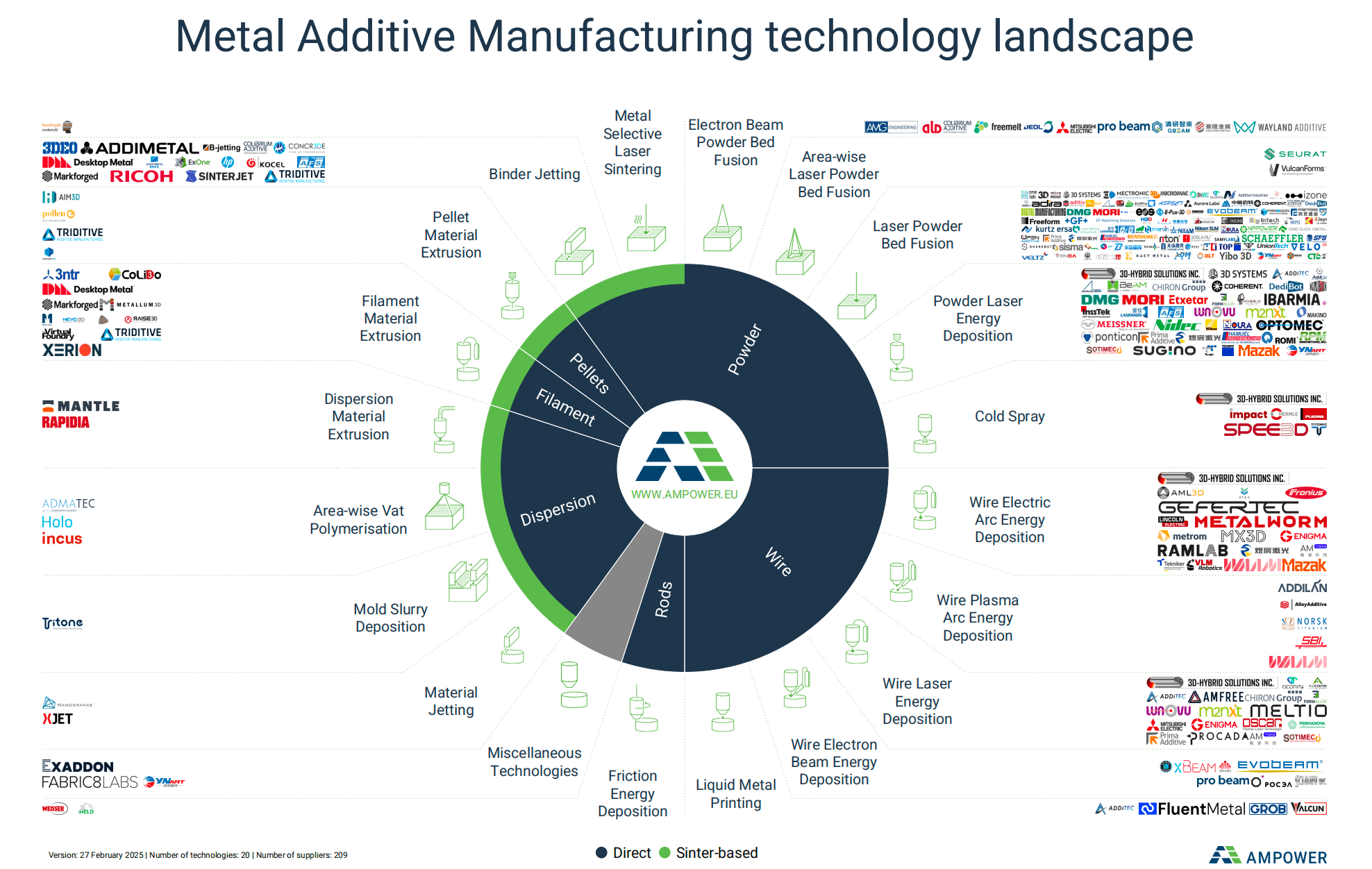
Source: AM Power
Attracted by the strong momentum in the development of metal AM industry, over the past two decades, numerous new technologies and manufacturers have sprung up.
According to AM Power’s latest research, there are essentially twenty different metal AM processes, distinguished by raw material (powder, wire, etc.), binding mechanism (melting, sintering, etc.), and energy source (laser, electron beam, arc, etc.). And as many as 209 3d printer suppliers have entered into the market.
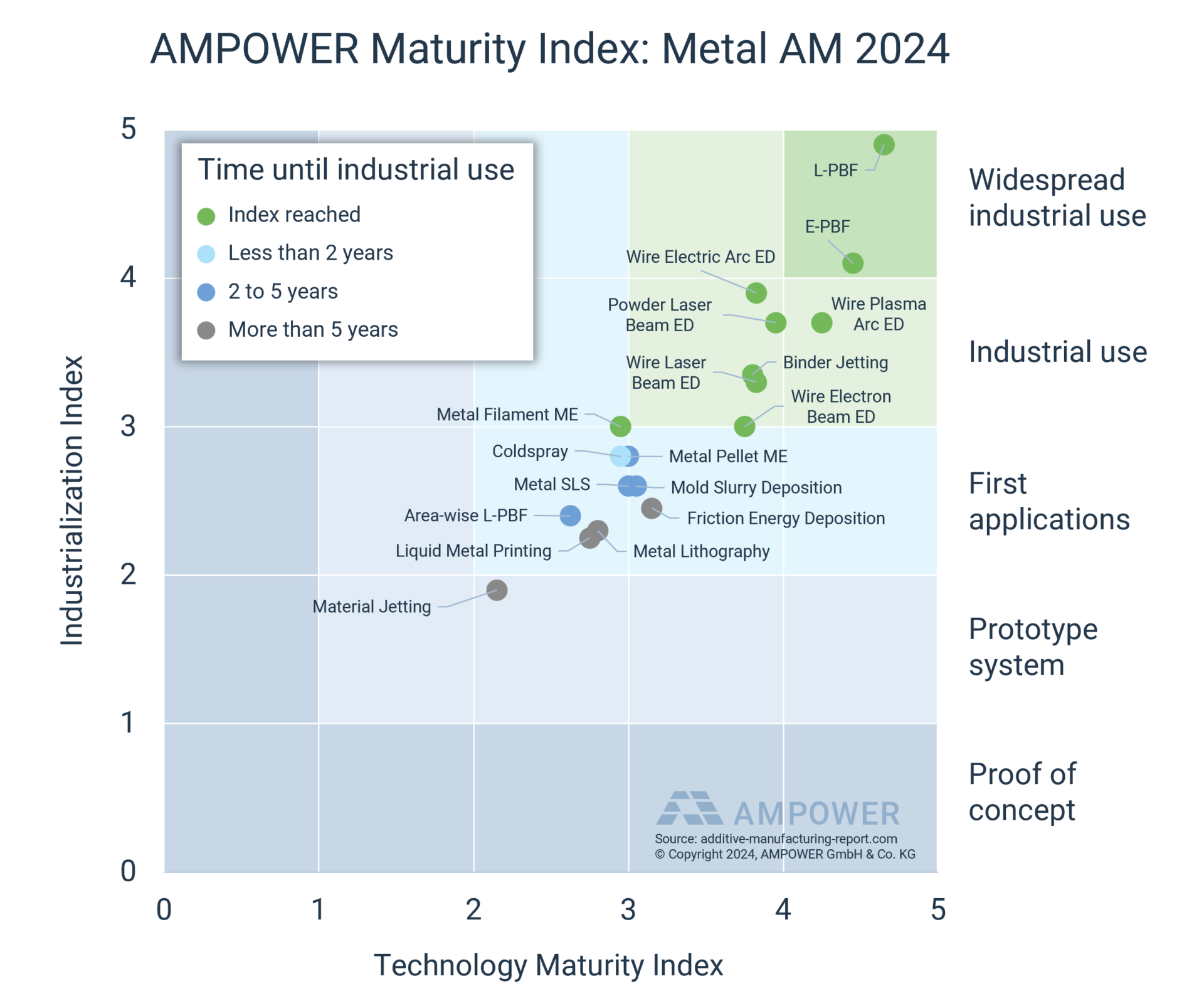
Source: AM Power
Despite 20 types of technologies on the market, not all of them are ready for widespread industrial use. According to the 2024 Metal AM Technology Maturity Index by AM Power,
-
Only L-PBF and E-PBF are widely used in industrial applications.
-
Seven other technologies — Wire Electric/Plasma Arc ED, Powder/Wire Laser Beam ED, Wire Electron Beam ED, Binder Jetting, and Metal Filament ME (Material Extrusion)—are suitable for industrial use but not yet widely adopted.
-
The rest may take 2 to 5 years, or even longer, to become industrially viable.
4 Metal 3D Printing Process Categories and 9 Core Technologies
Industrial-grade metal 3D printing relies almost exclusively on four specific processes: Powder Bed Fusion (PBF), Directed Energy Deposition (DED), Binder Jetting (BJ), and Material Extrusion (MEX).
Each process category includes several representative technologies. In addition, specialized methods such as Cold Spray are also used in industrial applications. Cold Spray is often considered a solid-state kinetic process rather than a traditional thermal melting technique. In total, nine key metal AM technologies are commonly discussed.
For a quick overview, the diagram below illustrates how the major metal 3D printing processes and technologies are organized.
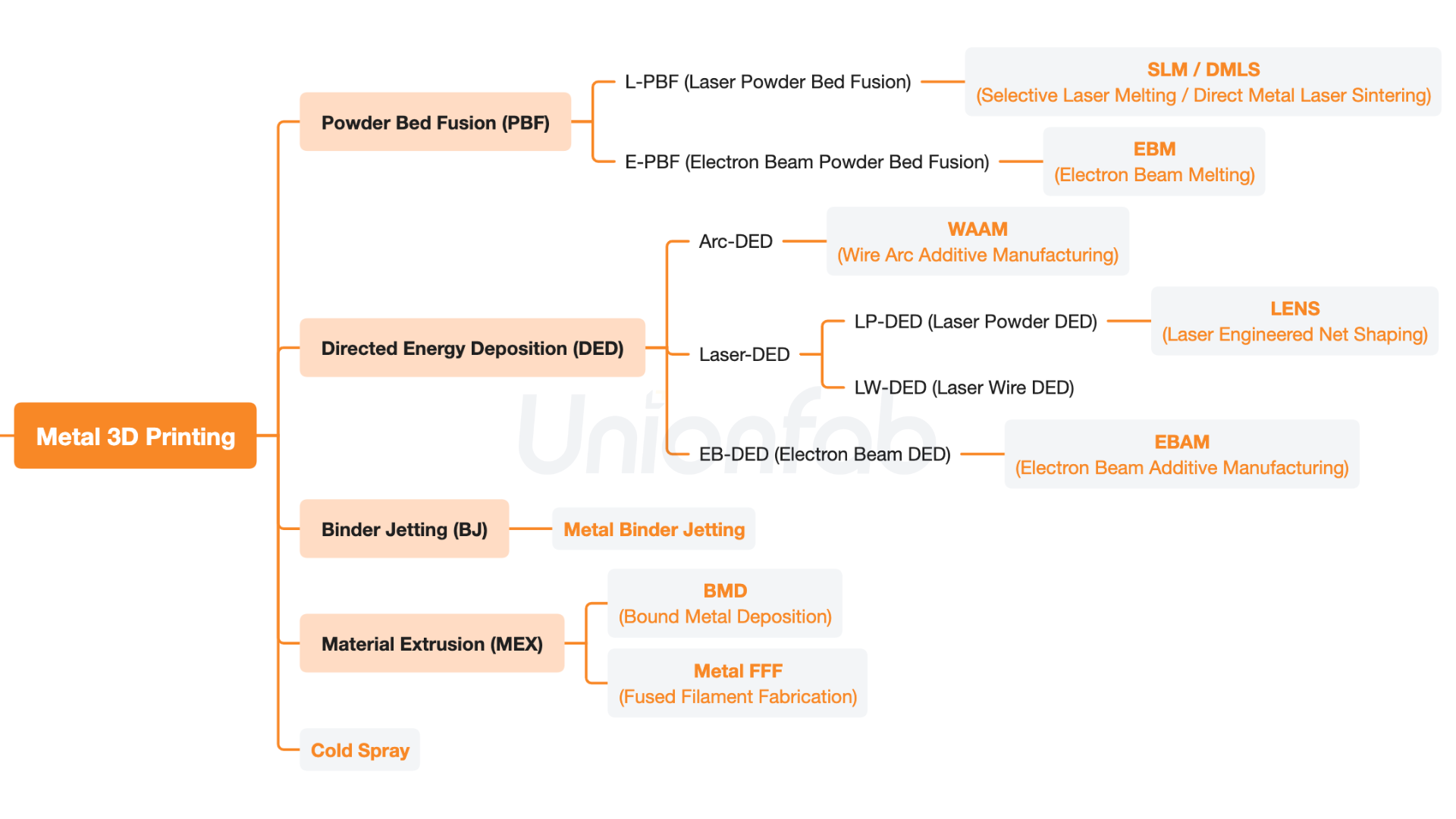
If you want a deeper understanding of how these processes work and how their underlying technologies differ, the following guides provide a detailed explanation:
-
Metal 3D Printing Processes Explained: PBF, DED, BJ, and MEX
-
Metal 3D Printing Technologies Explained: SLM, EBM, Metal Binder Jetting, and More
Below is a brief introduction to each process category and its representative technologies.
1. Powder Bed Fusion (PBF)
PBF processes use a concentrated thermal energy source to selectively melt and fuse layers of fine metal powder, producing dense, high-precision parts layer by layer.
Based on the type of energy source, metal PBF technologies are classified into two primary categories:
-
Laser Powder Bed Fusion (L-PBF): includes SLM and DMLS
-
Electron Beam Powder Bed Fusion (E-PBF): includes EBM
2. Directed Energy Deposition (DED)
DED uses a focused heat source to melt metal feedstock as it is deposited through a nozzle, forming material precisely where it is needed. DED technologies are typically classified by combining different energy sources (Laser, Electron Beam, or Arc) with different feedstock forms (Powder or Wire):
-
Arc + Wire = WAAM (Wire Arc Additive Manufacturing)
-
Laser + Powder = LENS (Laser Engineered Net Shaping) / LMD (Laser Metal Deposition)
-
Electron Beam + Wire = EBAM (Electron Beam Additive Manufacturing)
3. Binder Jetting (BJ)
Binder Jetting deposits a liquid binding agent onto layers of powdered material. While it applies to sand and ceramics, in industrial metal manufacturing, it often refers to Metal Binder Jetting (MBJ). This process creates a “green” part that must be sintered in a furnace to achieve final density.
4. Material Extrusion (MEX)
Metal MEX involves extruding binder-bound metal feedstock layer by layer. Like Binder Jetting, it forms a “green” part that is subsequently densified through debinding and furnace sintering to produce a near-solid metal component. Based on the form of the feedstock, it is categorized into:
-
Rod-Based Extrusion: Represented by BMD (Bound Metal Deposition).
-
Filament-Based Extrusion: Represented by Metal FFF (Fused Filament Fabrication).
How to Choose the Right Material for Metal 3D Printing
In metal 3D printing, pure metals are rarely used on their own. Instead, alloys dominate the field because they provide better strength, improved durability, and performance tailored to real-world applications.
So, how do you choose the right one?
It starts with understanding exactly what your part will go through. Will it face extreme temperatures? Does it need to be incredibly lightweight? Is corrosion resistance an absolute must, or is electrical conductivity your top priority?
Beyond these physical conditions, you might also need to consider wear resistance for high-friction components, biocompatibility for medical implants, and how the material choice aligns with your overall production budget.
Common Metal Alloys and Technology Compatibility
The table below breaks down the most common metal alloys, their key properties, typical applications, and their compatibility with the four main 3D printing technologies (PBF, DED, BJ, and MEX).
|
Category |
Common Alloys |
PBF Compatibility |
DED Compatibility |
BJ Compatibility |
MEX Compatibility |
Key Properties |
Typical Applications |
|---|---|---|---|---|---|---|---|
|
Titanium Alloys |
★★★★ |
★★★ |
★★ |
★ |
High strength-to-weight ratio, biocompatible |
Aerospace components, medical/dental implants |
|
|
Aluminum Alloys |
★★★★ |
★★ |
★ |
★ |
Lightweight, excellent thermal conductivity |
Automotive parts, heat exchangers |
|
|
Stainless Steels |
★★★★ |
★★★ |
★★★ |
★★ |
High corrosion resistance, moderate to high strength |
Industrial tooling, marine parts, medical devices |
|
|
Tool Steels |
H13, Maraging Steel |
★★★ |
★★★★ |
★★ |
★ |
High hardness, excellent wear resistance |
Injection molds, dies, cutting tools |
|
Nickel Superalloys |
Inconel 718, Inconel 625 |
★★★★ |
★★★★ |
★ |
✕ |
Extreme temperature and oxidation resistance |
Turbine blades, aerospace engine exhausts |
|
Cobalt-Chrome |
CoCrMo, CoCrW |
★★★★ |
★★★ |
★ |
★ |
High wear resistance, highly biocompatible |
Dental implants, orthopedic joint replacements |
|
Copper Alloys |
★★ |
★★★ |
★★ |
★★ |
Superior thermal and electrical conductivity |
Heat sinks, electrical connectors, induction coils |
Key Takeaways for Material Selection
If you have a limited budget and need a versatile, general-purpose material, choose Stainless Steels (316L, 17-4 PH) or Aluminum (AlSi10Mg, 6061).
-
Why? Stainless steels offer excellent durability, corrosion resistance, and printability at a fraction of the cost of exotic metals, making them the industry’s default workhorses. Alternatively, choose Aluminum if you need a budget-friendly option that is also lightweight with good thermal properties (ideal for automotive prototypes).
If you want to explore stainless steel and aluminum in metal 3D printing in more detail, including alloy comparisons, design tips, post-processing options, and performance differences across printing technologies, see the guides below:
If you prioritize an ultimate strength-to-weight ratio or strict biocompatibility, choose Titanium Alloys (Ti6Al4V).
-
Why? Titanium is the undisputed king of aerospace and medical AM. It is significantly lighter than steel yet remarkably strong, and its natural compatibility with the human body makes it a preferred choice for custom bone implants and high-performance racing components.
To learn more about titanium in metal 3D printing, including grades, properties, applications, technology comparisons, and service costs, read our Titanium 3D Printing Guide.
If your parts will face extreme heat or harsh, oxidative environments, choose Nickel-Based Superalloys (Inconel 625 / 718).
-
Why? Standard metals may warp, creep, or lose strength under extreme stress, but Inconel maintains its structural integrity even at rocket-engine or gas-turbine temperatures. Furthermore, because Inconel is notoriously difficult and expensive to CNC machine, 3D printing it is highly cost-effective.
To learn more about Inconel in metal 3D printing, read our Inconel 3D Printing Guide.
If you need ultimate wear resistance for manufacturing tooling, choose Tool Steels (H13, Maraging Steel) or Cobalt-Chrome.
-
Why? Tool steels can be heat-treated to achieve extreme hardness, drastically extending the lifespan of injection molds with conformal cooling channels. Conversely, choose Cobalt-Chrome if you need high wear resistance combined with biocompatibility (e.g., dental crowns or artificial joint replacements).
To learn more about maraging steel and its applications, see our Maraging Steel Guide.
If you need to rapidly dissipate heat or conduct electricity, choose Copper Alloys.
-
Why? Copper offers superior thermal and electrical conductivity compared to all other AM metals. While historically difficult to print due to its high laser reflectivity, recent advancements have made it the go-to material for complex heat sinks, induction coils, and high-efficiency heat exchangers.
To learn more about copper in metal 3D printing, read our Copper 3D Printing Guide.
How Much Does Metal 3D Printing Cost?
There is no single flat rate for metal 3D printing. While the process eliminates expensive upfront tooling costs, the exact price of a part depends on several factors, most notably the material and printing technology selected, the part’s volume and geometry, and the required post-processing and logistics.
To estimate the total cost, you can use this general framework:
Total Cost = Printing Cost (material price × part weight) + Post-Processing Cost + Packaging Fees + Shipping Fees + Customs Duty
-
Printing Cost: The primary expense, largely determined by the material price and the total material consumed.
-
Post-Processing: Costs vary depending on the required finishing steps, such as support removal, stress relief heat treatment, CNC machining for tight tolerances, or surface polishing.
-
Logistics and Fees: Specialized packaging (for example wooden crates for heavy parts), international shipping, and customs duties (typically 5%–20%) all contribute to the final landed cost.
How can engineering decisions reduce your costs?
Factors like part orientation, support design, and topology optimization significantly impact the final price. To see these variables in action, read our Ultimate Guide to Metal 3D Printing Cost.
Want a quick estimate for your specific part?
Use our Free Cost Calculator by uploading your CAD file to receive an instant quote.