
Explore Multi Jet Fusion — the fastest & most functional polymer 3D printing technology — with Unionfab’s ultimate guide.
Introduction
Need rapid production of durable, high-precision plastic parts? Multi Jet Fusion (MJF) is one of the most advanced 3D printing technologies available today—up to 10× faster than SLS, with excellent strength, fine detail, and smooth finishes straight off the printer.
In this guide, we’ll first dive into the essentials of MJF, covering how it works, its benefits, applications, and the materials and post-processing techniques it involves.
Next, we’ll compare MJF with other leading 3D printing technologies to help you determine the best fit for your project.
Finally, we’ll share design tips, cost insights, and guidance on selecting the ideal MJF service provider in 2025—ensuring the best outcome for your needs.
What is MJF 3D Printing?
Developed by HP, Multi Jet Fusion (MJF) is a powder bed fusion 3D printing process designed to produce functional, end-use plastic parts with industrial-grade performance. It primarily uses nylon-based materials like PA12 and PA11.
How Does Multi Jet Fusion Work?
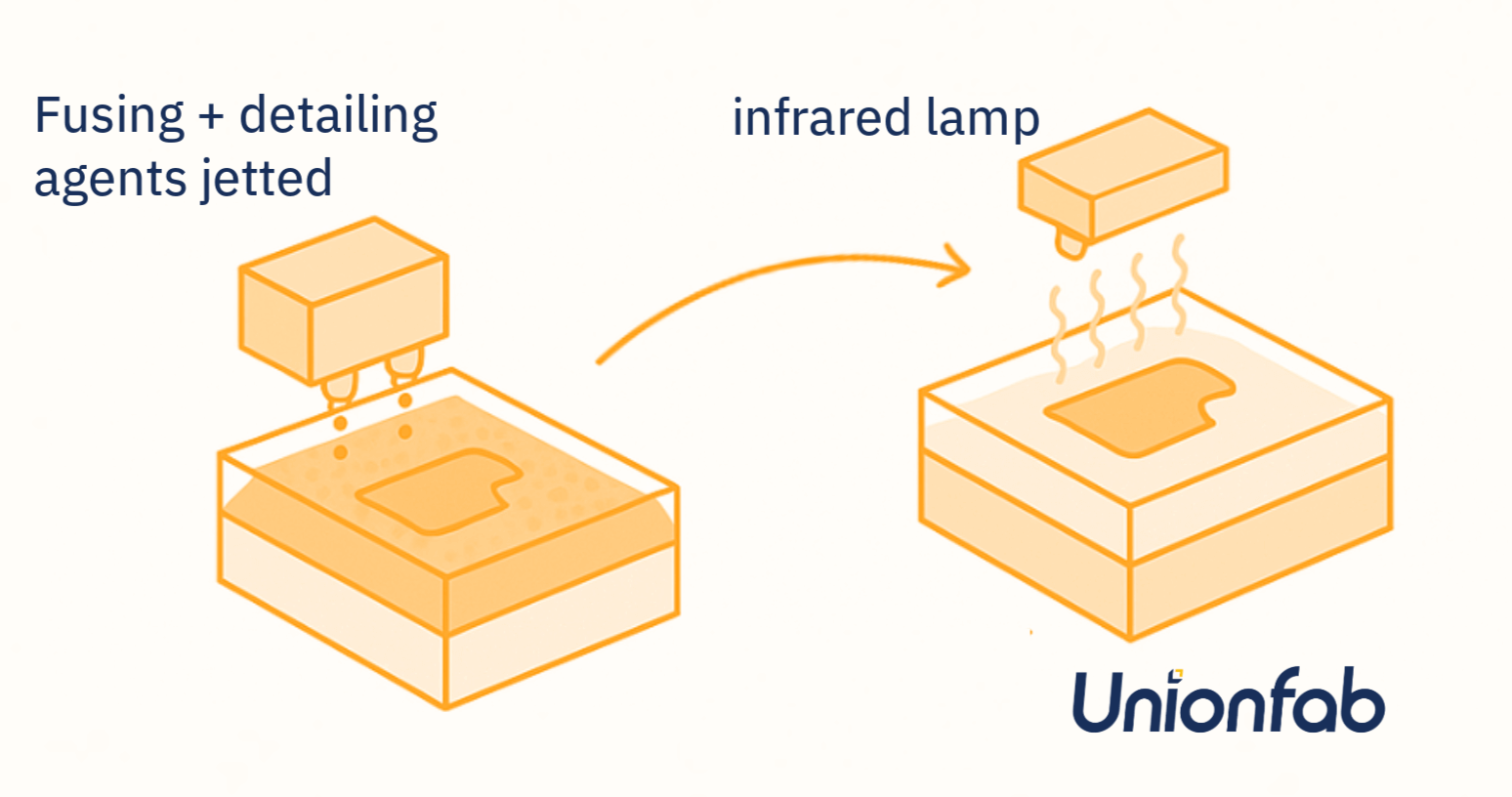
Instead of using lasers like SLS, MJF jets a fusing agent and detailing agent onto a powder bed, then fuses the material using infrared light. This speeds up the process and ensures consistent quality across builds.
Now let’s explore how this technology works under the hood:
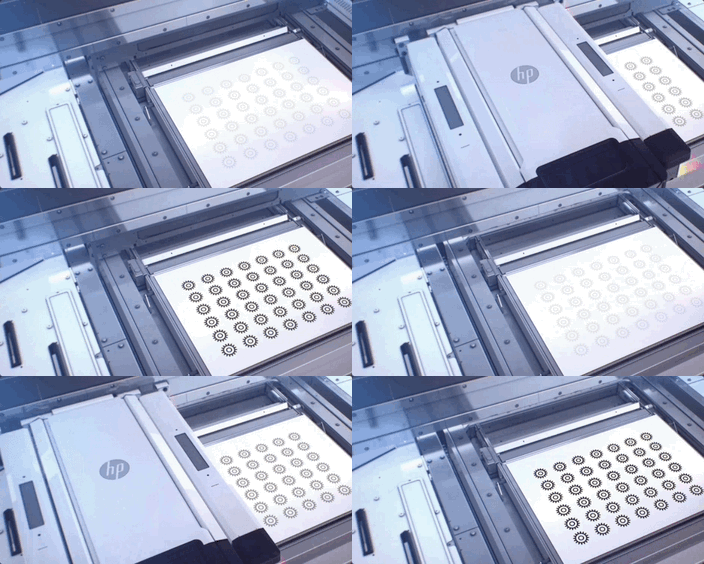
Source: MIT Fab Lab
Multi Jet Fusion builds parts layer by layer using a precise combination of fusing agents, detailing agents, and infrared energy.
Unlike SLS, which sinters powder point-by-point using a laser, MJF fuses entire cross-sections of a layer in a single pass, significantly boosting efficiency.
At the heart of this speed is HP’s dual-carriage system:
-
One carriage selectively jets fusing and detailing agents onto the powder bed.
-
The second carriage immediately follows with infrared energy, fusing the powdered areas marked by the agents.
This unique system enables simultaneous recoating and fusing, eliminating downtime between layers and making MJF up to 10x faster than selective laser sintering (SLS).
The result? High-quality, functional parts with excellent mechanical properties, minimal visible layer lines, and smoother surfaces—perfect for industries like automotive, medical, and aerospace.
Key Advantages of MJF
Multi Jet Fusion (MJF) offers a variety of benefits that make it an ideal choice for high-quality, rapid production. Below are the key advantages of MJF that set it apart from other 3D printing technologies:
● Ultra-fast Production
Up to 10× faster than SLS—ideal for rapid prototyping and small production runs.
● Functional Strength
Comparable to injection molding—great for parts that need to withstand stress and wear.
● High Precision
Supports complex geometries and fine details, making it suitable for intricate designs.
● Smooth Surface Finish
Parts come out with a uniform texture, ready for coloring and post-processing.
● Reduced Post-Processing
MJF produces fully functional parts that often require little to no post-production, reducing time and effort for finishing processes.
● Shorter Lead Times
MJF’s advanced automation allows for faster production cycles with minimal human intervention, ensuring quick turnaround times while maintaining high-quality results.
Common Applications of MJF
Multi Jet Fusion (MJF) is widely recognized for its versatility, making it a perfect fit for various industries and applications. With its speed, strength, and precision, MJF is used to produce everything from functional prototypes to end-use parts.
Below are some common applications where MJF technology shines:
|
Industry |
Applications |
Parts Made by Unionfab |
Key Benefits |
|---|---|---|---|
|
Automotive |
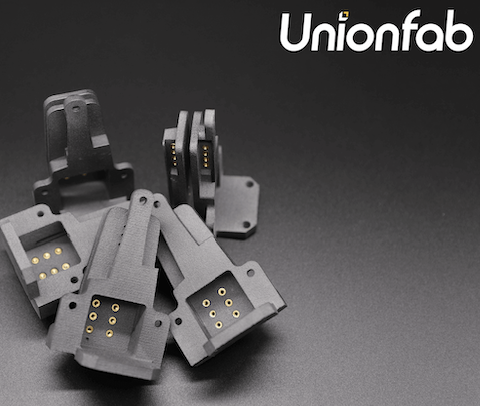
Functional parts, in-car brackets |
 |
Heat-resistant, lightweight |
|
Medical |
Prosthetics, orthopedic braces, medical instruments |
 |
Custom-fit, biocompatible materials |
|
Consumer Electronics |
Complex components, impact-resistant parts |
 |
High detail, durable |
|
Industrial Manufacturing |
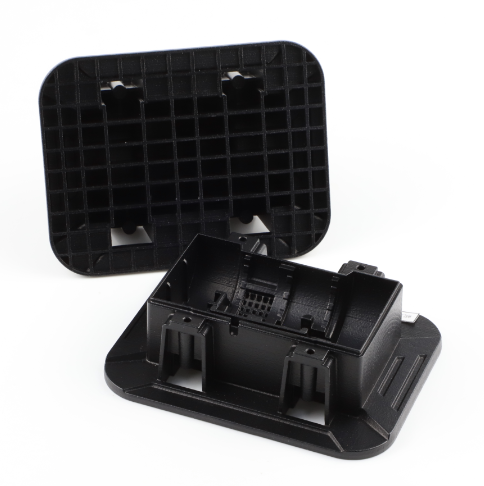
Jigs, custom tools, device casings |
 |
Strong, precise, customizable |
Material Options for MJF 3D Printing
In this section, we’ll walk you through the most popular materials for MJF 3D printing. First, we’ll give you a quick overview of the materials commonly used in MJF. Then, we’ll dive into a more detailed comparison of their key properties, so you can see how each one stacks up and choose the best fit for your project.
Overview of MJF Materials
Multi Jet Fusion (MJF) offers a wide range of materials that enable high-quality, rapid production of functional parts. The most commonly used materials in MJF are polyamide-based powders, each with unique properties suited for specific applications.
Below is an overview of the materials available, ranked by their frequency of use in MJF 3D printing.
|
Material Name |
Material Description |
Key Properties |
Notable Features |
Best For |
|---|---|---|---|---|
|
a polyamide powder synthesized from petroleum-based materials |
✔ High strength & stiffness ✔ Excellent chemical resistance ✔ Great dimensional stability |
✅ Strong & durable ✅ Sharp details ✅ Cost-effective |
● Functional prototypes ● End-use parts ● Industrial & automotive components |
|
|
a 40% glass bead-filled Nylon PA12 |
✔ High stiffness ✔ Heat resistant ✔ Rigid & dimensionally stable |
✅ 40% glass bead filling ✅ Less warping ✅ Ideal for mechanical strength |
● Jigs & fixtures ● Load-bearing parts ● Structural components |
|
|
a bio-based polyamide powder material derived from renewable resources such as plants or castor oil |
✔ More flexible than PA12 ✔ High impact resistance ✔ Bio-based & eco-friendly |
✅ Greater ductility ✅ High fatigue resistance ♻ Sustainable material |
● Medical devices ● Wearables ● Hinges, snap-fits & impact parts |
|
|
Polypropylene (PP) |
a thermoplastic material |
✔ Lightweight & flexible ✔ Excellent chemical resistance ✔ Good fatigue resistance |
✅ Watertight capabilities ✅ Low density ✅ Cost-saving for high-volume |
● Automotive reservoirs ● Medical housings ● Fluid systems |
|
Thermoplastic Polyurethane |
✔ Rubber-like flexibility ✔ High wear & abrasion resistance ✔ Multiple Shore options |
✅ Impact absorbing ✅ Highly elastic ✅ Great for soft-touch surfaces |
● Footwear ● Seals & gaskets ● Ergonomic components |
In-Depth Comparison of MJF Material Properties
Building on the previous section, we now dive deeper into the specific properties of each MJF material. In this comparison, we evaluate key performance metrics such as tensile strength, stiffness, impact strength, flexibility, durability, and more.
The following bar chart offers a visual representation of how each material measures up across these properties, helping you make informed decisions based on your project requirements.
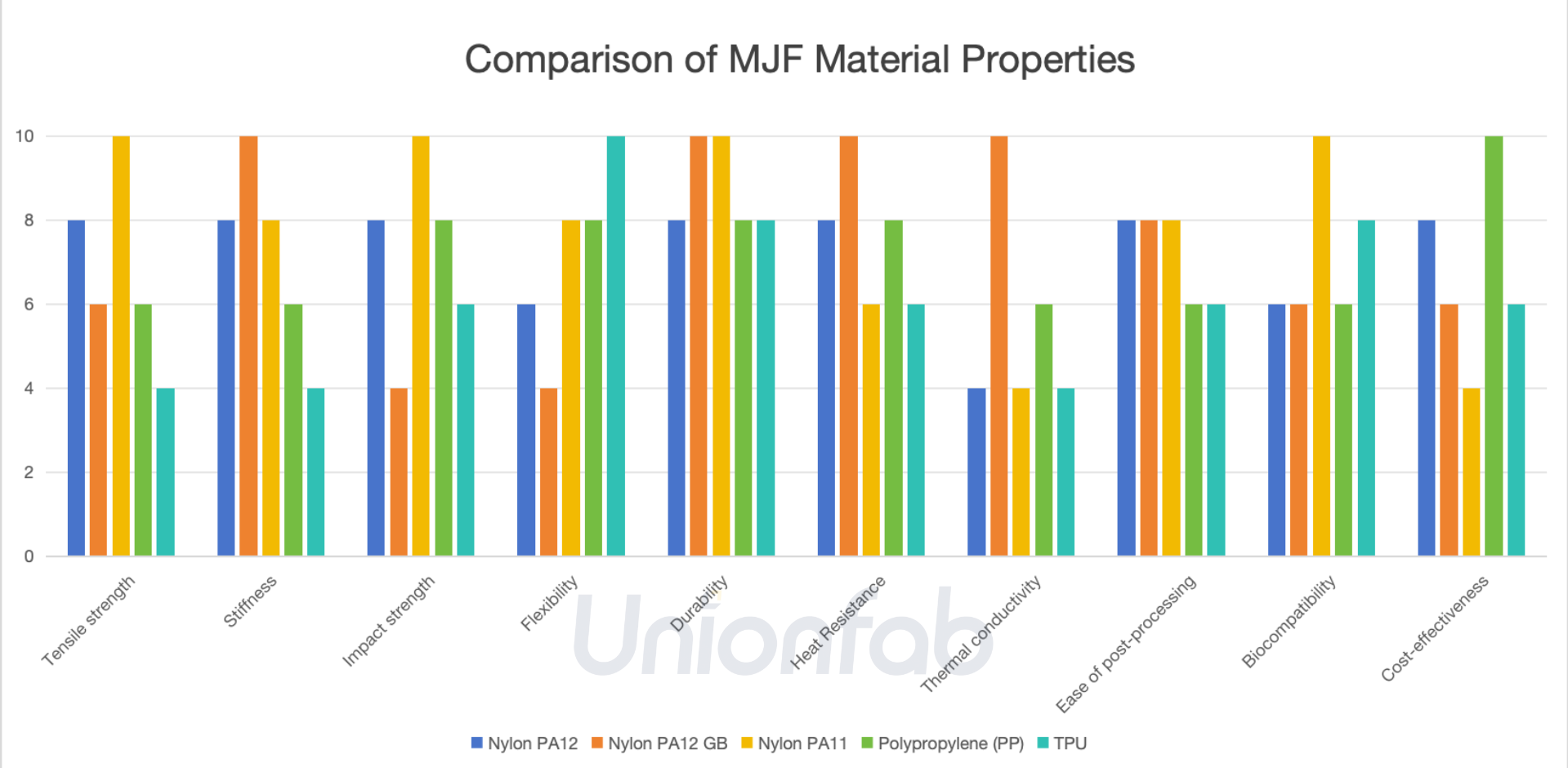
Below is a table that provides a more detailed breakdown of the properties covered in the bar chart above.
|
Property |
Nylon PA12 |
Nylon PA12 GB |
Nylon PA11 |
Polypropylene (PP) |
TPU |
|---|---|---|---|---|---|
|
Tensile strength |
⭐️⭐️⭐️⭐ ️~45-48 MPa |
⭐️⭐️⭐ ️~30 MPa |
⭐️⭐️⭐️⭐️⭐️ ~48 MPa |
⭐️⭐️⭐ ~️30 MPa |
⭐️⭐ ~️10 MPa |
|
Stiffness |
⭐️⭐️⭐️⭐ ️Good stiffness for structural stability. |
⭐️⭐️⭐️⭐️⭐️ Excellent stiffness, ideal for rigid parts. |
⭐️⭐️⭐️⭐ ️Balanced stiffness and flexibility. |
⭐️⭐️⭐ ️Moderate stiffness for general use. |
⭐️⭐ ️Low stiffness, highly elastic. |
|
Impact strength |
⭐️⭐️⭐️⭐ ️Good impact resistance for daily applications. |
⭐️⭐ ️Low impact resistance due to glass bead filling. |
⭐️⭐️⭐️⭐️⭐ ️Superior impact resistance, tough and durable. |
⭐️⭐️⭐️⭐ ️High impact resistance, resistant to shocks. |
⭐️⭐️⭐ ️Moderate impact resistance, absorbs collisions well. |
|
Flexibility |
⭐️⭐️⭐ ️Moderate flexibility, balanced for various applications. |
⭐️⭐ ️Low flexibility, more rigid material. |
⭐️⭐️⭐️⭐ ️High flexibility, ideal for parts requiring bending or flexibility. |
⭐️⭐️⭐️⭐️ Very flexible, great for soft, bendable parts. |
⭐️⭐️⭐️⭐️⭐ ️Extremely flexible, highly elastic, ideal for wearables. |
|
Durability |
⭐️⭐️⭐️⭐ ️Durable, resistant to wear and tear under normal conditions. |
⭐️⭐️⭐️⭐️⭐ ️Excellent durability, performs well under extreme conditions. |
⭐️⭐️⭐️⭐️⭐ ️Very durable, performs excellently in tough environments. |
⭐️⭐️⭐️⭐ ️Good durability, suitable for long-lasting parts in regular conditions. |
⭐️⭐️⭐️⭐ ️High durability, suitable for wear-resistant applications. |
|
Heat Resistance |
⭐️⭐️⭐️⭐ ~120–150°C, slightly higher than Nylon 11 |
⭐️⭐️⭐️⭐️⭐ ~150–200°C |
⭐️⭐️⭐ ️~130°C |
⭐️⭐️⭐️⭐ ️Good heat resistance (100–120°C). |
⭐️⭐️⭐ ️High heat resistance (150°C), ideal for high-temperature environments. |
|
Thermal conductivity |
⭐️⭐ ️Low thermal conductivity, not ideal for heat dissipation. |
⭐️⭐️⭐️⭐️⭐ ️High thermal conductivity, great for heat dissipation. |
⭐️⭐ ️Low thermal conductivity, similar to PA12. |
⭐️⭐️⭐ ️Moderate thermal conductivity, dissipates heat reasonably well. |
⭐️⭐ ️Low thermal conductivity, not ideal for heat management. |
|
Ease of post-processing |
⭐️⭐️⭐️⭐ ️Easy to process with standard post-processing techniques. |
⭐️⭐️⭐️⭐ ️Easy to process, similar to PA12. |
⭐️⭐️⭐️⭐ ️Easy to work with, minimal post-processing required. |
⭐️⭐️⭐ ️Moderate post-processing required. |
⭐️⭐️⭐ ️Moderate difficulty, may require more work than PA12. |
|
Biocompatibility |
⭐️⭐️⭐ ️Good biocompatibility, suitable for some medical uses. |
⭐️⭐️⭐ ️Moderate biocompatibility, suitable for certain medical parts. |
⭐️⭐️⭐️⭐️⭐ ️Very high biocompatibility, ideal for medical and body-contact parts. |
⭐️⭐️⭐ ️Moderate biocompatibility, can be used in medical applications. |
⭐️⭐️⭐️⭐ ️High biocompatibility, used in medical and wearable devices. |
|
Cost-effectiveness |
⭐️⭐️⭐️⭐ ️Most affordable among nylons, mature production & sufficient supply. |
⭐️⭐️⭐ ️More expensive than PA12, due to glass bead filling and modified processing. |
⭐️⭐ ️Most expensive (bio-based raw material, complex production process). |
⭐️⭐️⭐️⭐️⭐ ️Most cost-effective overall, low raw material and production costs. |
⭐️⭐️⭐ ️Moderately priced, higher than PA12 but lower than PA11. |
Key Takeaways
● Nylon PA12: Strong, durable, and cost-effective, ideal for functional prototypes and end-use parts.
● Nylon PA12 GB: Reinforced with glass beads for higher stiffness and durability, perfect for structural and load-bearing parts.
● Nylon PA11: Bio-based, flexible, and impact-resistant, great for medical devices and wearables.
● Polypropylene (PP): Lightweight, cost-effective, and chemical-resistant, suitable for automotive and medical applications.
● TPU: Highly flexible and wear-resistant, best for impact-absorbing parts like footwear and seals.
If you want to learn more about nylon 3D printing or TPU 3D printing, be sure to check out our dedicated guides.
Post-Processing Techniques for MJF 3D Printing
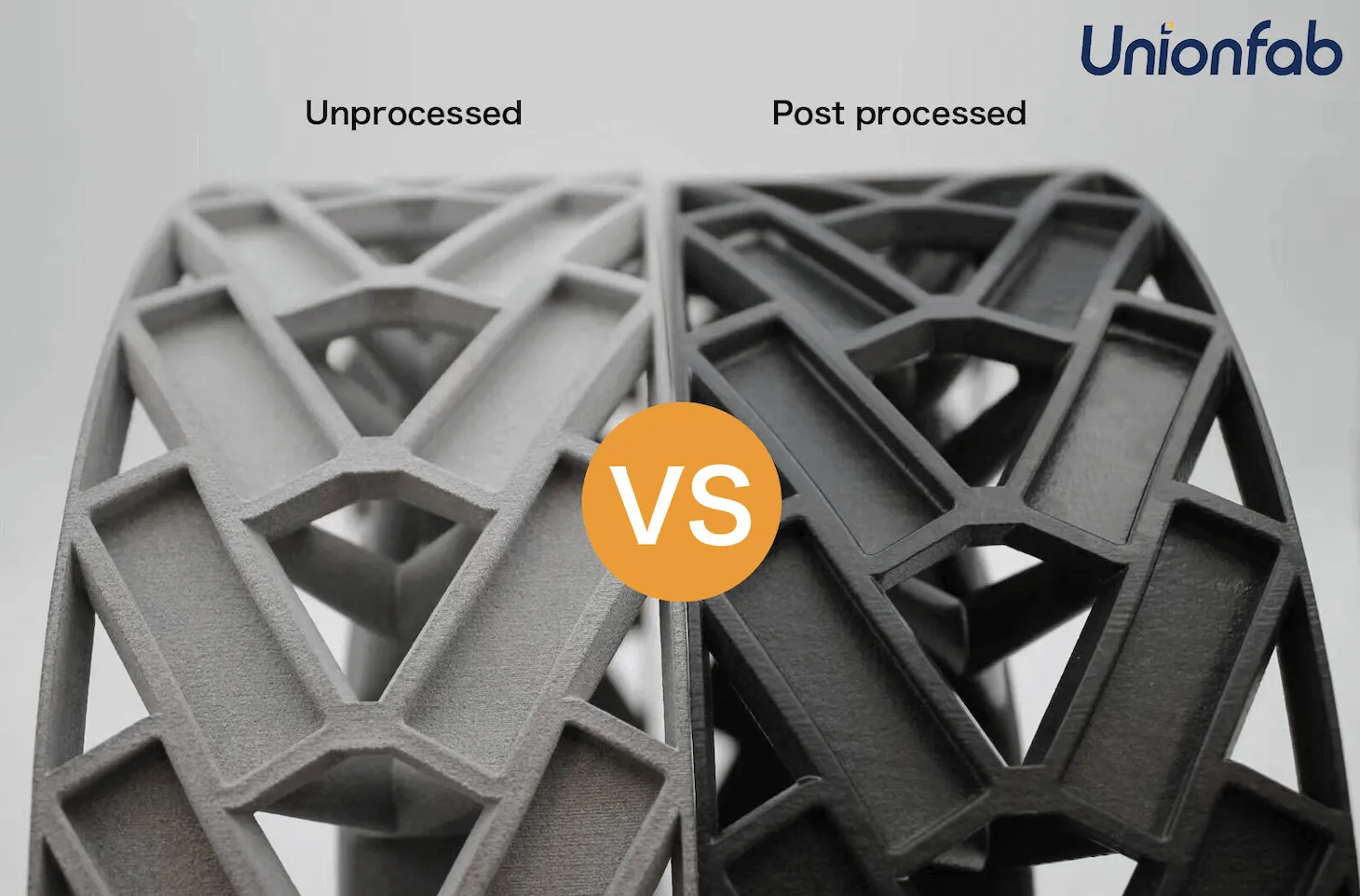
Post-processing is essential to improve aesthetics, surface quality, and environmental performance—especially for end-use or customer-facing products.
-
Cleaning & Surface Smoothing: