
Figure out what is SLM 3D Printing / Metal LPBF and choose the most suitable service provider in one guide.
Introduction
When producing metal parts, especially complex and custom designs, with traditional manufacturing methods, we may often face these challenges:
-
Significant time and money on mold creation upfront;
-
Low material efficiency, leading to considerable waste;
-
Inadequate precision, causing rework and delayed deliveries.
All of them will greatly impact production timelines, costs, and overall efficiency. And this is where metal 3d printing, especially SLM 3d printing, comes in as a game-changer, providing solutions with better value for money.
What Is SLM 3D Printing?
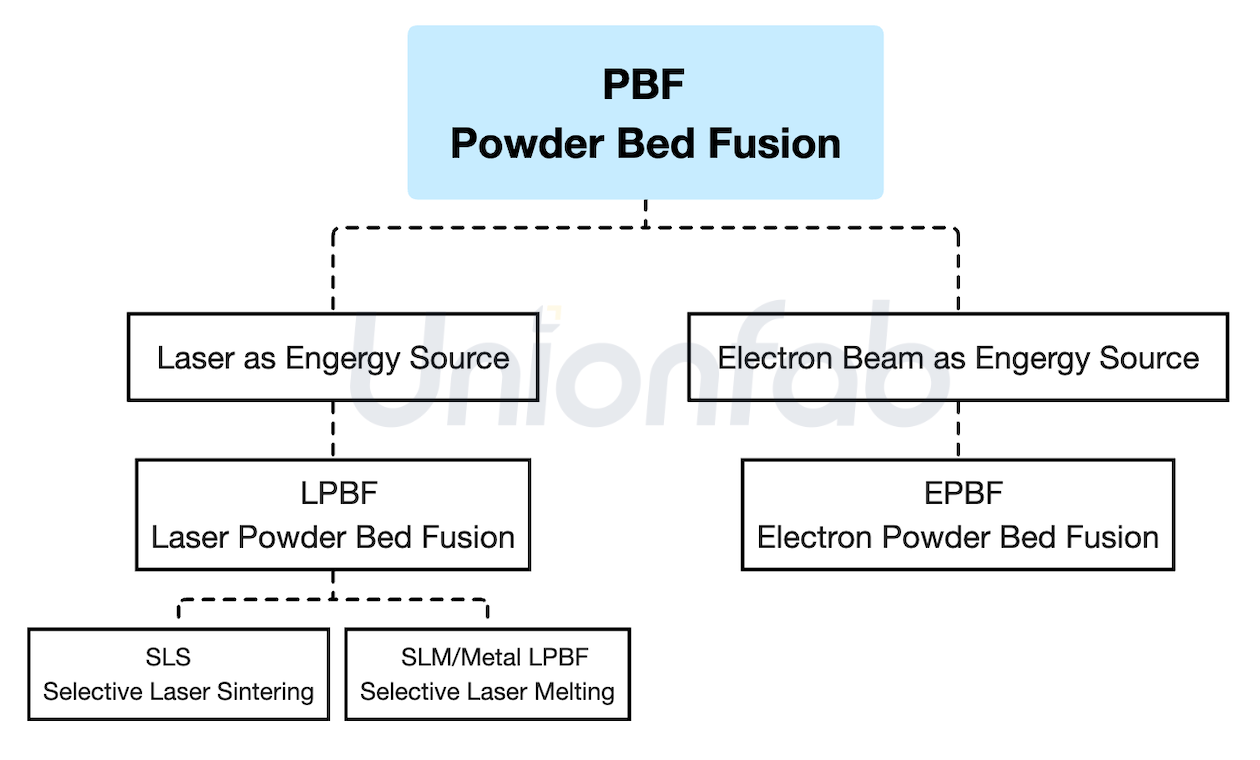
SLM stands for Selective Laser Melting. It uses a high-powered laser to fully melt metal powder layer by layer. Based on different material states, energy sources, and forming methods uses, the Standard ISO/ASTM 52900:2021 has divided 3d printing technologies into 7 categories, among which, SLM can be categorized as Powder Bed Fusion (PBF).
More precisely, SLM, along with Selective Laser Sintering (SLS), belongs to Laser Powder Bed Fusion (LPBF) because they use laser. Since SLM only processes metal, it’s also called metal LPBF.
Beyond lasers, the PBF category also includes EPBF (Electron Powder Bed Fusion), which utilizes an electron beam as its energy source.
How Does SLM 3D Printing Work?
Components of a SLM 3D Printer
To understand how SLM 3d printing works, it is necessary to figure out what a SLM 3d printer is composed of and how each part functions. An SLM 3d printer usually consists of the following critical components.
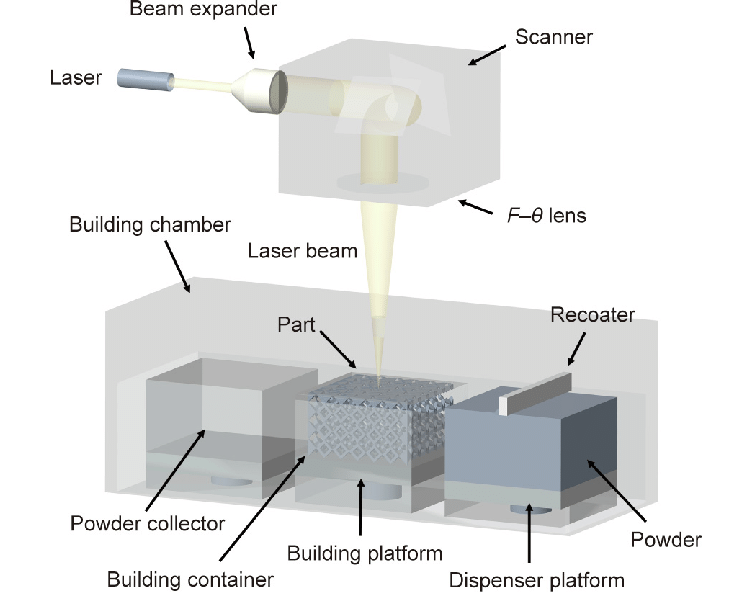
|
Part |
Component |
Description |
|---|---|---|
|
Scanning System |
Laser |
Commonly fiber lasers; |
|
Lens |
Focuses the laser for precise work. |
|
|
Scanner |
Directs the laser to the desired locations |
|
|
Building Chamber |
Building Space |
The enclosed area where printing happens. |
|
Building Platform |
Also called substrate or printing bed; |
|
|
Powder Collector |
Gathers leftover powder for reuse. |
|
|
Powder Supplier |
Feeds new powder for printing. |
|
|
Recoater |
Spreads a thin layer of powder evenly. |
|
|
Inert Gas |
Commonly argon or nitrogen; |
|
|
Control System |
Computer |
Oversees and controls the entire printing. |
SLM 3D Printing Process
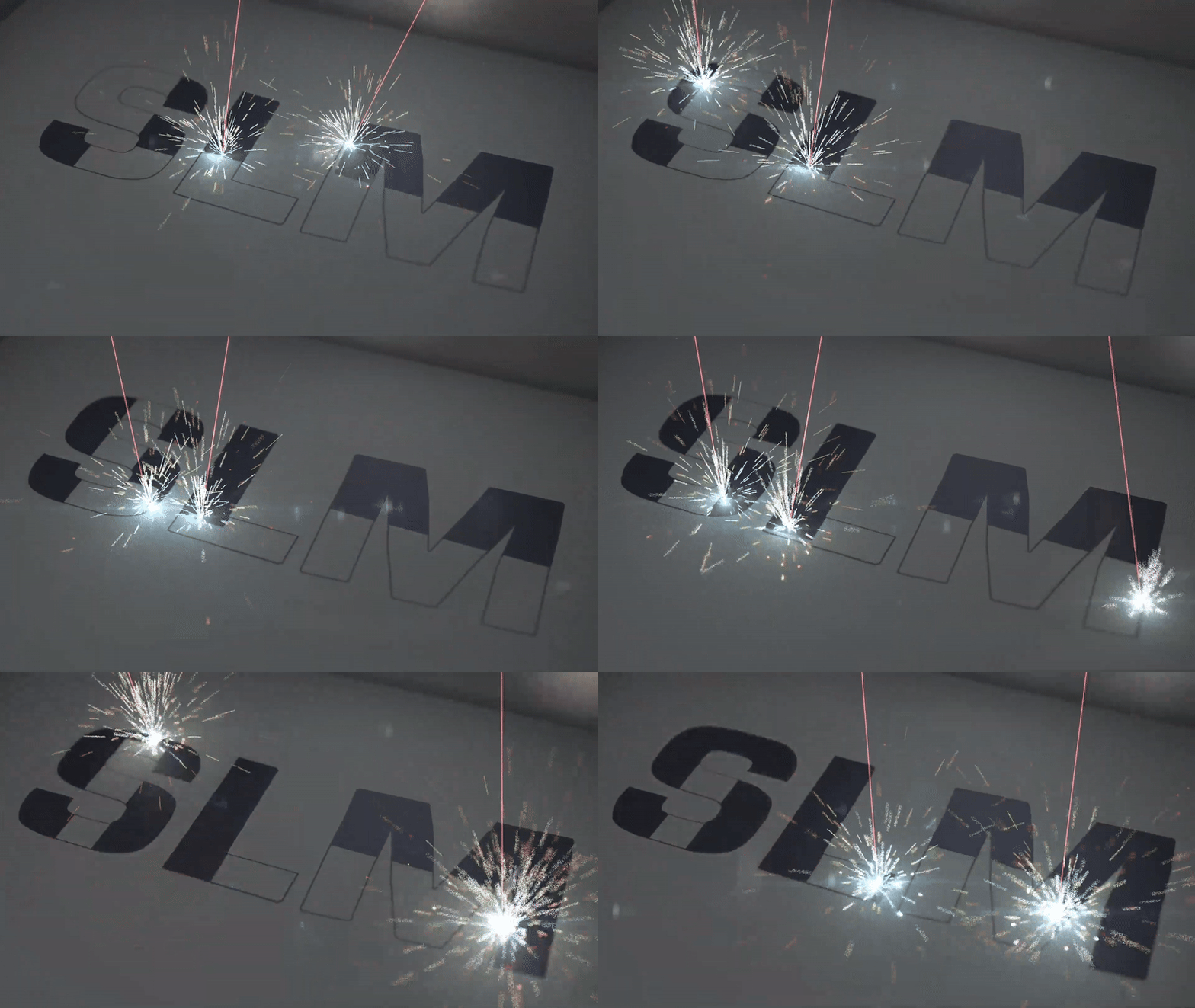
After knowing what is a SLM 3d printer, it will be easier for us to understand the process. The SLM 3D printing process usually involves the following steps:
-
3D Model Preparation and Slicing: A digital 3D model of the object is created using CAD software and then sliced into thin layers.
-
Powder Spreading: A thin layer of metal powder (usually 20 to 50 μm) is spread evenly across the build platform using the recoater.
-
Laser Melting: The laser selectively melts the powder according to the cross-sectional pattern of the first layer, fusing the particles together.
-
Layer Completion: Once a layer is complete, the build platform lowers by one layer thickness, and a new layer of powder is spread.
-
Repetition: Steps 2-4 are repeated until the entire object is built.
-
Post-Processing: After printing, the object is removed from the build platform, and excess powder is removed. Additional post-processing, such as heat treatment or surface finishing, may be required.
Materials Used in SLM 3D Printing
The common metals used in SLM 3d printing are Aluminum Alloy, Steel, Titanium and Copper Alloy. Here we have compared their performances in different properties.
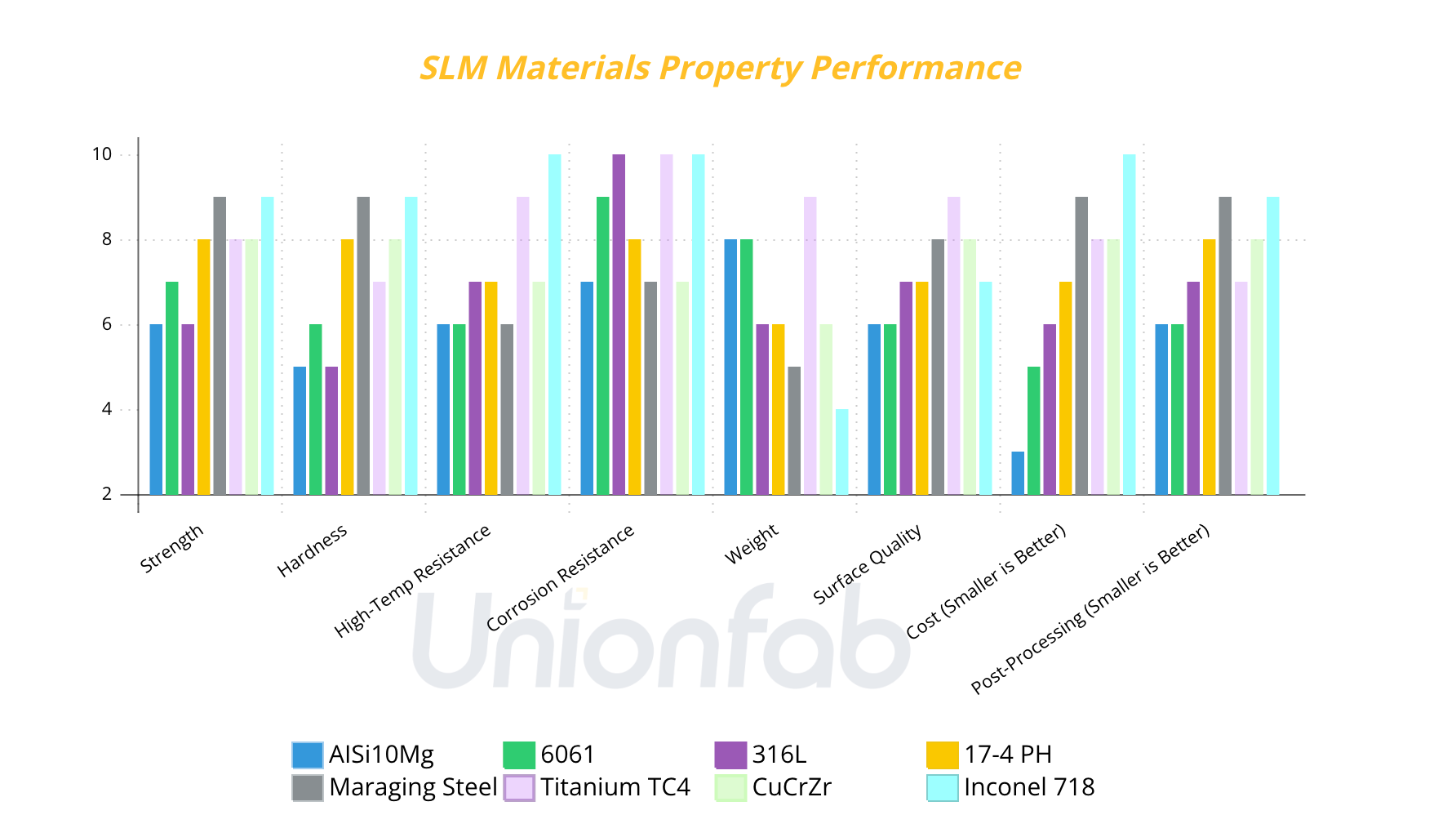
Note: The values in the chart are only used for comparing materials’ performance in different aspects above and have no other meaning.
As we can see from the bar chart,
-
AlSi10Mg and 6061: Suitable for lightweight, low-cost applications, but have poor high-temperature resistance.
-
316L: Excellent corrosion resistance, ideal for medical and chemical industries.
-
17-4PH and Maraging Steel: High strength, suitable for high-strength structural components and molds, but come with higher costs.
-
TC4: Excellent overall performance, ideal for aerospace and medical fields, but expensive.
-
CuCrZr: Outstanding thermal performance, suitable for thermal management and electronics, but relatively heavy.
-
Inconel 718: Exceptional strength, high-temperature resistance, corrosion resistance, and durability, making it ideal for extreme environments like aerospace and power generation.
For more details of the properties of the materials above, you can download their data sheets from our material page.
Design Guideline for SLM 3D Printing
After gaining a basic understanding of SLM technology and materials, it is also essential to strictly follow certain guidelines in model design to prevent potential issues and ensure smooth printing.
|
Layer Thickness |
0.035 mm |
|---|---|
|
Min. Wall Thickness |
0.5 mm |
|
Tolerances |
±0.2 mm |
|
Min. Hole Diameter |
1 mm |
|
Min. Internal Channel Diameter |
2 mm |
Beyond following the design guideline above, some other key considerations should be taken into account as well before you print the model.
1. Optimize Geometric Design
-
Avoid Overhangs: Minimize overhang angles (typically >45° requires supports) to reduce support needs and simplify post-processing.
-
Add Fillets: Use fillets on sharp corners to reduce stress and prevent cracks or deformation during printing.
2. Reduce Support Needs
-
Self-Supporting Designs:
-
Use arch or triangular structures for natural support.
-
Design overhangs in stepped shapes to keep angles below 45°.
-
-
Shorten Overhangs: If overhangs are unavoidable, reduce their length to minimize supports.
3. Choose the Best Print Orientation
-
Surface Quality: Orient critical surfaces (e.g., exteriors) toward the top or sides to reduce support marks.
-
Thermal Stress: Ensure even mass distribution to avoid overheating or warping.
-
Function First: Prioritize functional needs (e.g., load direction) when selecting orientation.
4. Check 3D Files
-
Ensure the model is watertight (no holes or gaps).
-
Fix non-manifold edges (misconnected faces).
-
Verify normals are correct (all faces outward).
-
Use 10-20 triangles per mm for balanced file size and accuracy.
5. Design Proper Part Clearance
-
When designing parts that need to fit together or move relative to each other, ensure sufficient clearance for smooth assembly or motion.
-
Assembly Clearance: At least 0.3mm to avoid fitting issues.
-
Motion Clearance: At least 0.5mm for smooth movement, and 1mm or more for parts requiring frequent motion
6. Simulate and Validate
-
Simulation Tools: Use software (e.g., ANSYS, SimScale) to predict thermal stress and deformation, optimizing the design.
-
Prototype Testing: Print a small prototype to test design feasibility and print quality.
DMLS vs. SLM vs. EBM vs. Binder Jetting
In addition to SLM, there are several other metal 3D printing technologies: DMLS, EBM, and Binder Jetting. The table below distinguishes these technologies to help you choose the most suitable one.
Before comparing, we need to clarify that DMLS and SLM are two different names for the same technology, MLPBF. Therefore, in the table below, we will list them under the same column. For more information on the naming of DMLS and SLM, we recommend reading the article by All3dp.
|
Aspect |
EBM |
||
|---|---|---|---|
|
Energy Source |
Laser |
Electron Beam |
Liquid Binder |
|
Environment |
Inert Gas (e.g., argon, nitrogen) |
Vacuum |
Ambient Air |
|
Build Speed |
Moderate |
High |
Very High |
|
Material Options |
Wide range (aluminum, titanium, stainless steel, nickel alloys, etc.) |
Limited |
Moderate range (stainless steel, tool steel, titanium, etc.) |
|
Support Structures |
Required |
Minimal |
Not required (binder holds powder in place) |
|
Part Size Limitations |
Limited by build chamber size |
Limited by vacuum chamber size |
Larger build volumes possible |
|
Post-Processing |
Required |
Minimal |
Required (sintering, infiltration, surface finishing) |
|
Part Density |
Fully dense |
Fully dense |
Porous |
|
Mechanical Strength |
High |
High |
Lower |
|
Surface Finish |
Excellent |
Rough |
Moderate (typically requires post-processing) |
|
Material Waste |
Moderate |
Moderate |
Low |
|
Real-World Usability |
Best for high-performance, complex parts |
Best for high-strength, high-temperature applications |
Best for prototyping, tooling, and low-to-medium stress components |
|
Scalability |
Moderate (limited by build chamber size and speed) |
Moderate (limited by vacuum chamber size) |
High (large build volumes, batch processing) |
|
Cost |
High |
High |
Lower (scalable) |
|
Operator Skill Level |
High |
High |
Low to Moderate (easier to operate) |
|
Ease of Use |
Moderate |
Moderate |
Easy |
|
Environmental Impact |
Moderate (inert gas usage, energy-intensive) |
Moderate (vacuum system energy consumption) |
Lower (no heat source, less energy-intensive) |
|
Multi-Material Capability |
Limited (typically single-material) |
Limited (typically single-material) |
Possible (supports multi-material printing, though not common) |
Conclusion
-
SLM is ideal for high-precision, complex parts with excellent mechanical properties but comes at a higher cost.
-
EBM is suited for high-strength applications, especially in aerospace and medical fields, with faster build speeds but limited material options.
-
Binder Jetting is cost-effective and scalable for prototyping and less demanding applications but requires post-processing to achieve desired properties.
Comparison of SLM 3D Printing Service Providers
To help you choose the most suitable 3d printing service provider, we have listed a table to compare the key metal 3d printing service providers around the world in terms of the following aspects.
|
Service Provider |
One-line Profile |
Technology |
Material |
Max. Build Volume |
Online Instant Quoting |
*Sample Cost |
|---|---|---|---|---|---|---|
|
Xometry |
A US-based Global Factory-less 3D Printing Supply Chain Platform |
SLM/DMLS, Binder Jetting |
SLM/DMLS: Aluminum AlSiMg Stainless Steel 17-4 Stainless Steel 316L Binder Jetting: 316i (316SS/Brz) 420i (420SS/Brz) Stainless Steel 316L |
SLM/DMLS: 250 x 250 x 250 mm Binder Jetting: 400 x 250 x 250 mm |
✅ |
$575.26 |
|
Unionfab |
A China-based Global 3D Printing Service Provider with Six In-house Factories |
SLM/DMLS, Binder Jetting |
SLM/DMLS: Aluminum (AlSi10Mg, 6061) Titanium (TC4) Stainless Steel 316L Stainless Steel 17-4PH Maraging Steel Inconel 625 CuCrZr Binder Jetting: Stainless Steel 316L Stainless Steel 17-4PH |
SLM/DMLS: 400 x 300 x 400 mm Binder Jetting: 400 x 250 x 250 mm |
✅ |
$45.49 |
|
Facfox |
A China-based Global Factory-less 3D Printing Supply Chain Platform |
SLM/DMLS, Binder Jetting |
SLM/DMLS: Aluminum (Alsi10Mg) Titanium(Ti61Al4V) Stainless Steel 316L Stainless Steel 17-4PH Maraging Steel Inconel 718 Inconel 625 Cobalt Chrome(CoCrMo) Binder Jetting: CJP Fullcolor Sandstone |
SLM/DMLS: 500 x 500 x 1000 mm Binder Jetting: 254 x 381 x 203 mm |
✅ |
$46.93 |
|
Additive3dasia |
A Singapore-based 3D Printing Company |
SLM/DMLS |
SLM/DMLS: Stainless Steel 316L Aluminum AlSiMg Titanium Alloy Ti6Al4V Miraging Steel (MS1-18Ni300) |
Not Mention |
❌ |
/ |
|
Zelta3d |
A Singapore-based 3D Printing Company |
SLM/DMLS |
SLM/DMLS: Stainless Steel 316L Aluminum AlSiMg |
Not Mention |
✅ |
$92.07 |
|
Addimen |
A Spain-based 3D Printing Company |
SLM/DMLS |
SLM/DMLS: Stainless Steel 316L Martensitic Steel Aluminum AlSiMg Titanium Alloy Ti6Al4V Cu Inconel 718 |
Not Mention |
❌ |
/ |
|
Jellypipe |
A Germany-based Global Factory-less 3D Printing Supply Chain Platform |
SLM/DMLS |
SLM/DMLS: Stainless Steel 316L Stainless Steel 17-4PH Aluminum AlSi9Cu3 Titanium TiAl6V4v Martensitic Nickel Steel Corrax (Corrosion-Resistant Tool Steel) Inconel 718 |
Not Mention |
✅ |
$439.56 |
|
Rapidobject |
A Germany-based Global 3D Printing Service Provider with Factories |
SLM/DMLS |
SLM/DMLS: Stainless Steel 316L Aluminum AlSiMg Inconel 718 Titanium Bronze |
Not Mention |
✅ |
$583.56 |
*Note: The Sample cost is calculated via the online instant quoating systems of each company above.
Volume: 74.62 cm³; Material: Stainless Steel 316L; Tech: Selective Laser Melting (SLM)
In summary,
-
Xometry, Unionfab, and Facfox offer both SLM/DMLS and Binder Jetting Technologies.
-
Xometry, Unionfab, and Facfox provide relatively rich metal materials.
-
Facfox has the largest build volume for SLM/DMLS: 500 x 500 x 1000 mm.
-
Xometry and Unionfab provide the largest build volume for Binder Jetting: 400 x 250 x 250 mm.
-
Xometry, Facfox, and Jellypipe are factory-less supply chain platforms, while Unionfab and Rapidobject have self-owned factories.
Below is the score of some companies above on Trustpilot. You can click the score to see feedback from real customers.
|
Company |
Xometry |
Unionfab |
Facfox |
|---|---|---|---|
|
Trustpilot Score |
How to Reduce SLM 3D Printing Cost?
Below are some specific strategies from the design perspective that can help minimize printing costs.
Simplify Design
-
Minimize complex details and overhangs to reduce print time and material usage.
-
Avoid excessive supports by using self-supporting angles or simpler shapes.
Optimize Wall Thickness & Structure
-
Use minimal wall thickness for strength.
-
Design parts as hollow or with lattice structures to save material and weight.
Optimize Print Orientation
-
Adjust part orientation to reduce supports and print time.
-
Choose the most efficient orientation (horizontal/vertical) to reduce waste.
Choose Cost-Effective Materials
-
Select cheaper materials when performance isn’t critical.
-
Use lightweight designs like lattices to reduce material use.
<