Explore titanium 3D printing, including service costs, material grades, material properties, key applications, and comparisons of major technologies.
Introduction
Titanium has long been celebrated for its unique combination of lightness, strength, and biocompatibility, making it a go-to material for high-performance applications.
Unlike traditional machining methods, which often result in material waste and higher costs, titanium 3D printing offers a more efficient and cost-effective solution, making it a game-changer for industries at the cutting edge of innovation.
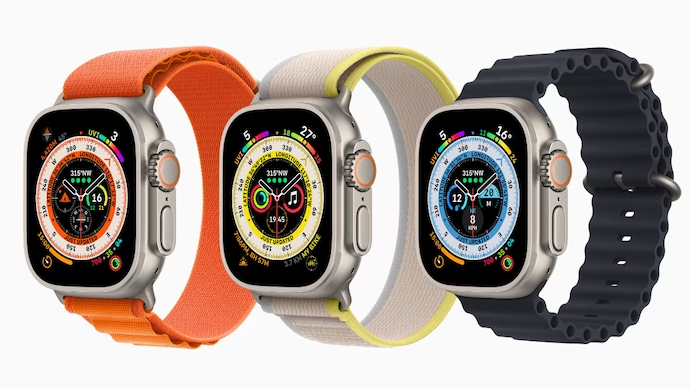
One of the most exciting developments in titanium 3D printing is its adoption by leading tech giants like Apple. The iPhone 15 Pro and Apple Watch Ultra both incorporate Grade 5 Titanium (Ti-6Al-4V)—the same high-strength alloy used in aviation and medical implants.
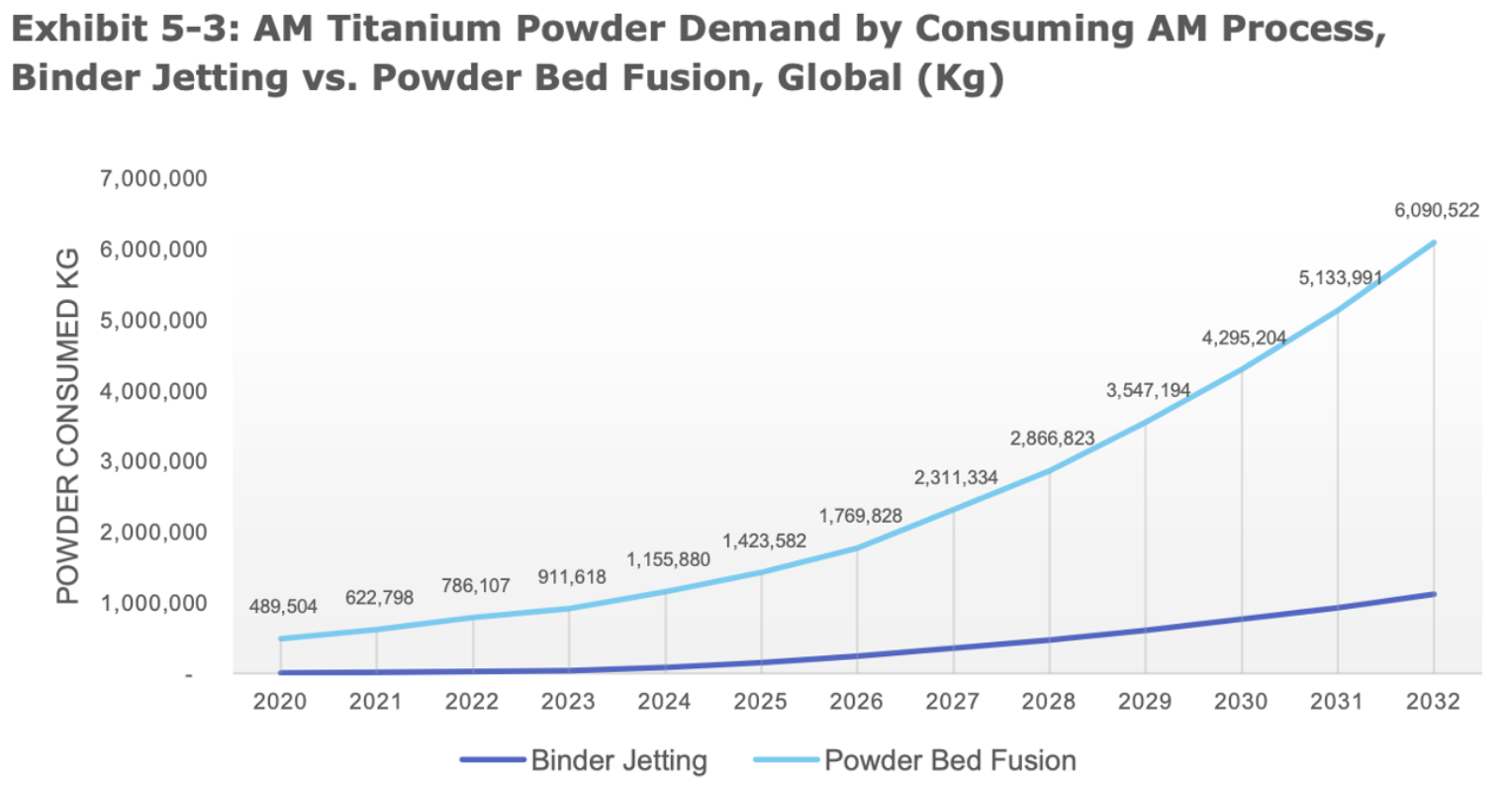
According to a report by Additive Manufacturing Research (AM Research), the titanium 3D printing market is projected to grow from $214 million in 2023 to a remarkable $1.4 billion by 2032. With 3D printing enabling more precise, cost-effective Titanium production, pushing the boundaries of design and performance.
Why Is 3D Printing Ideal for Titanium?
Titanium is an excellent material for 3D printing, not just because of its physical properties, but also because traditional machining methods struggle with it.
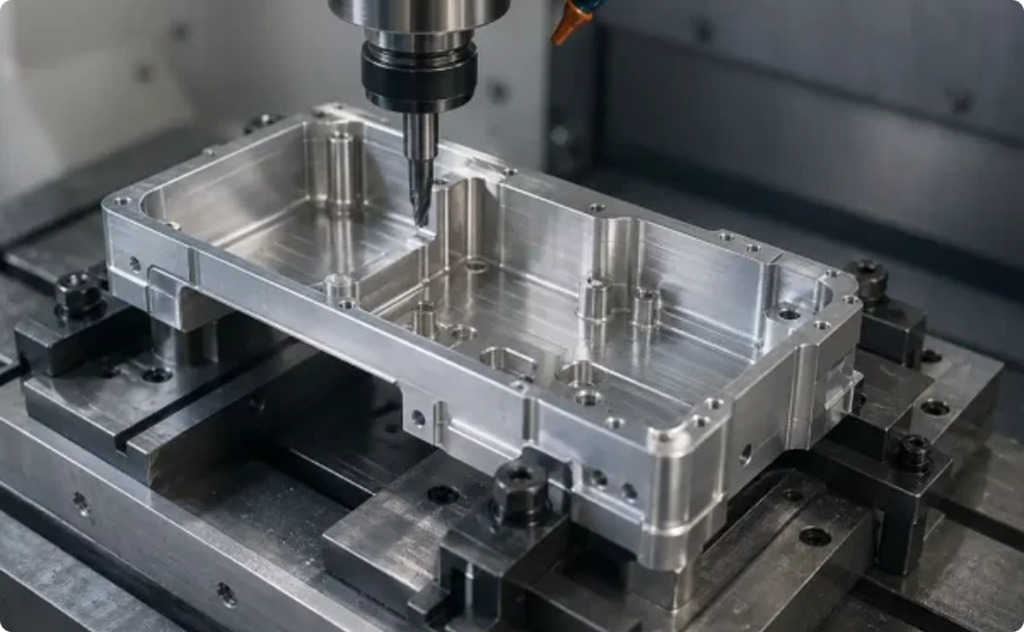
In conventional manufacturing, Titanium is notoriously difficult to machine due to its hardness and tendency to wear down cutting tools quickly. It also has an extremely high Buy-to-Fly Ratio—a term used in aerospace to describe material waste. When machining a Titanium part from a solid billet, up to 90% of the raw material is lost as chips. This inefficiency drives up costs, making Titanium components expensive and time-consuming to produce.
Enter 3D printing, which solves these challenges in three key ways:
-
Material Efficiency – Additive manufacturing builds parts layer by layer, meaning only the necessary material is used. This drastically reduces waste and lowers costs.
-
Complex Geometries – 3D printing enables topology optimization, where software designs organic, lightweight structures that wouldn’t be possible with traditional machining. This is crucial in aerospace and medical applications.
-
No Tool Wear – Since Titanium 3D printing doesn’t involve cutting tools, manufacturers avoid costly tool replacements and downtime.
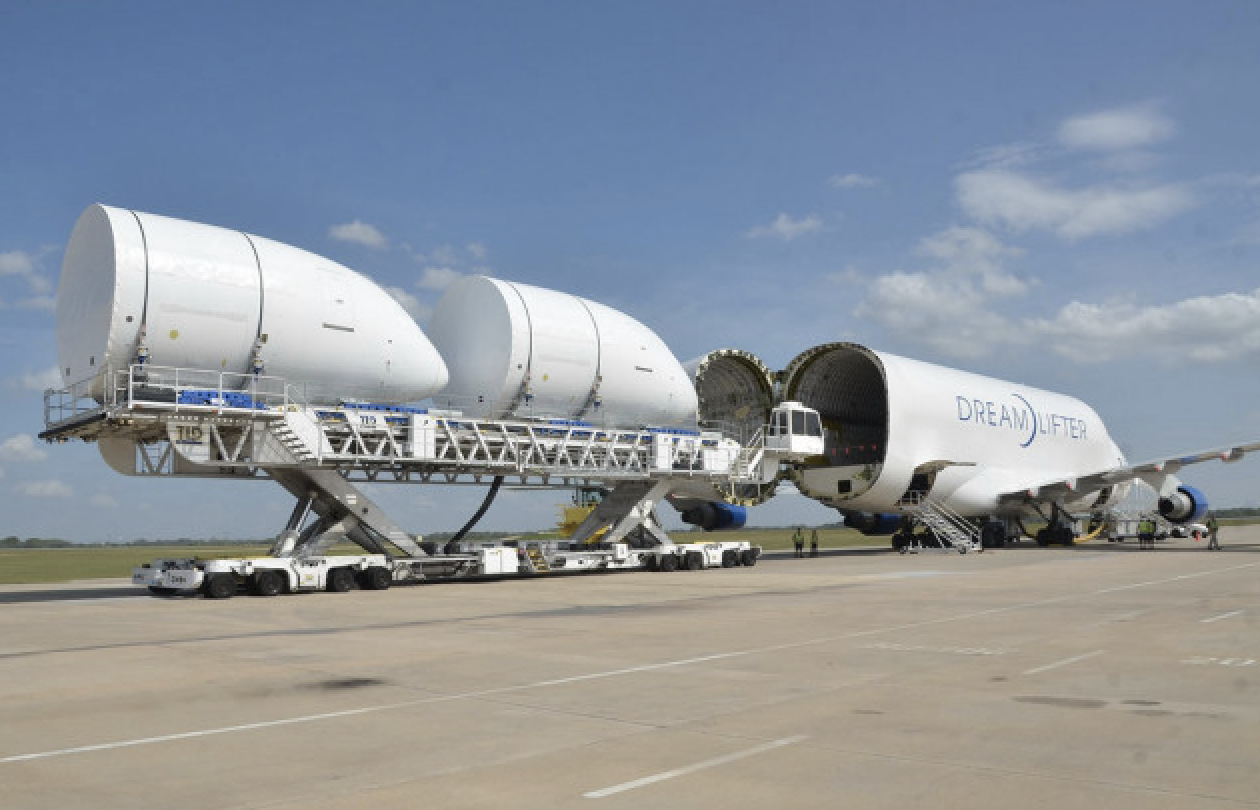
A perfect example is Boeing’s collaboration with Norsk Titanium to incorporate 3D-printed titanium parts in the 787 Dreamliner. By replacing traditionally manufactured components with additively manufactured structural titanium parts, Boeing anticipates saving $2 million to $3 million per aircraft, thereby enhancing the 787’s profitability.
Common Titanium Grades in 3D Printing
|
Material Grade |
Composition |
Key Features |
Typical Applications |
|---|---|---|---|
|
Ti6Al4V (Ti64, Grade 5) |
6% Aluminum, 4% Vanadium, 90% Titanium |
High strength, corrosion-resistant, excellent fatigue resistance |
Aerospace, medical implants, high-performance automotive parts |
|
Equivalent to Ti6Al4V |
Equivalent to Ti6Al4V |
Aerospace, medical, industrial applications |
|
|
Ti6Al4V ELI (Grade 23) |
Extra-low interstitial version of Ti64 |
Superior biocompatibility, improved fracture toughness |
Medical implants, dental prosthetics, surgical tools |
|
Commercially Pure Titanium (Grade 1-4) |
99%+ Titanium, small amounts of oxygen, iron, carbon |
Increased ductility, corrosion resistance, lower strength than Ti64 |
Chemical processing, marine applications, biomedical implants |
*TC4 is the same material as Ti6Al4V but follows Chinese GB/T standards.
Among the different grades of Titanium, Ti6Al4V (also known as TC4 in China) is the most commonly used in 3D printing. This alloy, made up of 6% aluminum and 4% vanadium, offers a superior balance of strength, weight, and corrosion resistance.
Titanium Properties and Their Applications in 3D Printing
Let’s take a look at titanium’s key properties and see how they translate into real-world applications for 3D printed parts.
High Strength-to-Weight Ratio: Aerospace & Cycling
Titanium offers steel-like strength at roughly 45% less weight, giving it an exceptional strength-to-density ratio. This makes it highly valuable in 3D printing titanium aerospace applications. Aircraft components such as brackets, mounts, and structural connectors can be optimized for strength while minimizing mass.
The same property benefits high-performance cycling. Titanium’s low weight and fatigue resistance suit bike frames and other load-bearing parts. For example, 3D printed titanium bike lugs create strong metal joints between carbon tubes, enabling durable and highly customized bike designs.
Biocompatibility: Medical & Dental
Source: Unionfab
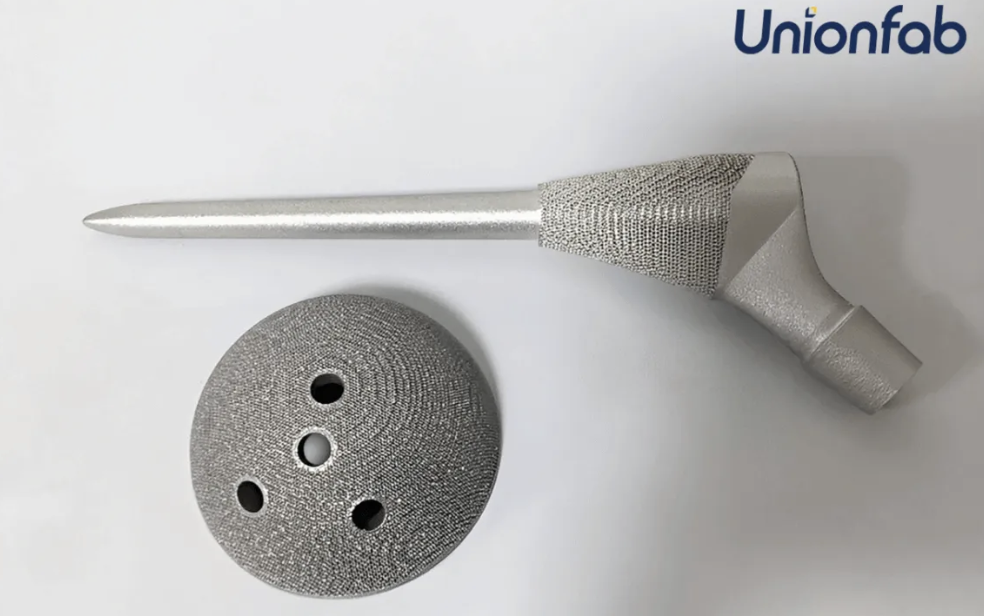
Titanium is one of the few metals readily accepted by the human body. Its non-toxic, non-allergenic nature supports osseointegration, allowing bone to grow directly into the implant surface.
While dental implants are now widely produced using additive manufacturing, the greater impact is in patient-specific orthopedic care. Custom implants, such as radius and ulna reconstructions, can be designed directly from CT or MRI data to achieve precise anatomical fit.
Today, 3D printed titanium is used for jaw replacements, rib cages, femoral scaffolds, spinal components, as well as vertebral cages, hip, and knee implants.
High-Temperature Resistance: Automotive
Standard titanium alloys like Ti6Al4V maintain high mechanical strength at elevated temperatures (up to 400°C–500°C) where aluminum components would significantly weaken or fail. This thermal stability makes it well suited for demanding automotive environments.
In motorsports and high-performance engineering, 3D printed titanium components such as brake calipers, lightweight exhaust manifolds (and complex routing nodes), and turbochargers (specifically compressor wheels) combine low weight with excellent heat resistance.
Corrosion Resistance: Energy & Marine
Titanium naturally forms a stable oxide layer on its surface, creating a passive barrier that protects it from corrosion caused by seawater, chlorides, and many aggressive chemicals.
For this reason, titanium is especially valuable in energy, offshore, and marine environments, where components are continuously exposed to saltwater, pressure, and harsh chemical conditions.
Parts such as pump impellers and subsea manifolds can maintain long-term performance with minimal degradation, making titanium well suited for applications that demand reliability over decades of service life.
How Do Titanium 3D Printing Technologies Work?
The main technologies used in titanium 3D printing include Selective Laser Melting (SLM) / Direct Metal Laser Sintering (DMLS), Electron Beam Melting (EBM), Binder Jetting (BJ), Direct Energy Deposition (DED) and Cold Spray.
Among these, SLM/DMLS and EBM are the industry standards for titanium, particularly in the aerospace and medical sectors, due to their ability to produce dense, high-strength components with the reactive nature of titanium in mind.
|
Technology |
How It Works |
Titanium Compatibility |
Primary Advantages |
|---|---|---|---|
|
High-power laser melts powder in an inert gas environment. |
Ti6Al4V, CP Ti (Grades 1-4) |
High precision & surface finish. |
|
|
EBM |
Electron beam melts powder in a high-temperature vacuum. |
Ti6Al4V, Grade 23 (ELI) |
Reduced stress, no oxygen pick-up. |
|
Liquid binder joins powder; requires furnace sintering. |
Titanium-based powders |
High volume, lower cost. |
|
|
DED |
Laser, electron beam, or arc melts powder or wire as it is deposited onto a substrate. |
Ti6Al4V (powder & wire), CP Ti |
Repairs & massive components. |
|
Cold Spray |
Supersonic kinetic energy bonds particles without melting. |
Titanium powder particles |
No thermal distortion; ideal for coatings. |
To learn more about how each technology works in practice, please read our in-depth guide on Metal 3D Printing Technologies.
Technology Comparison: SLM/DMLS vs. EBM vs. BJ vs. DED vs. Cold Spray
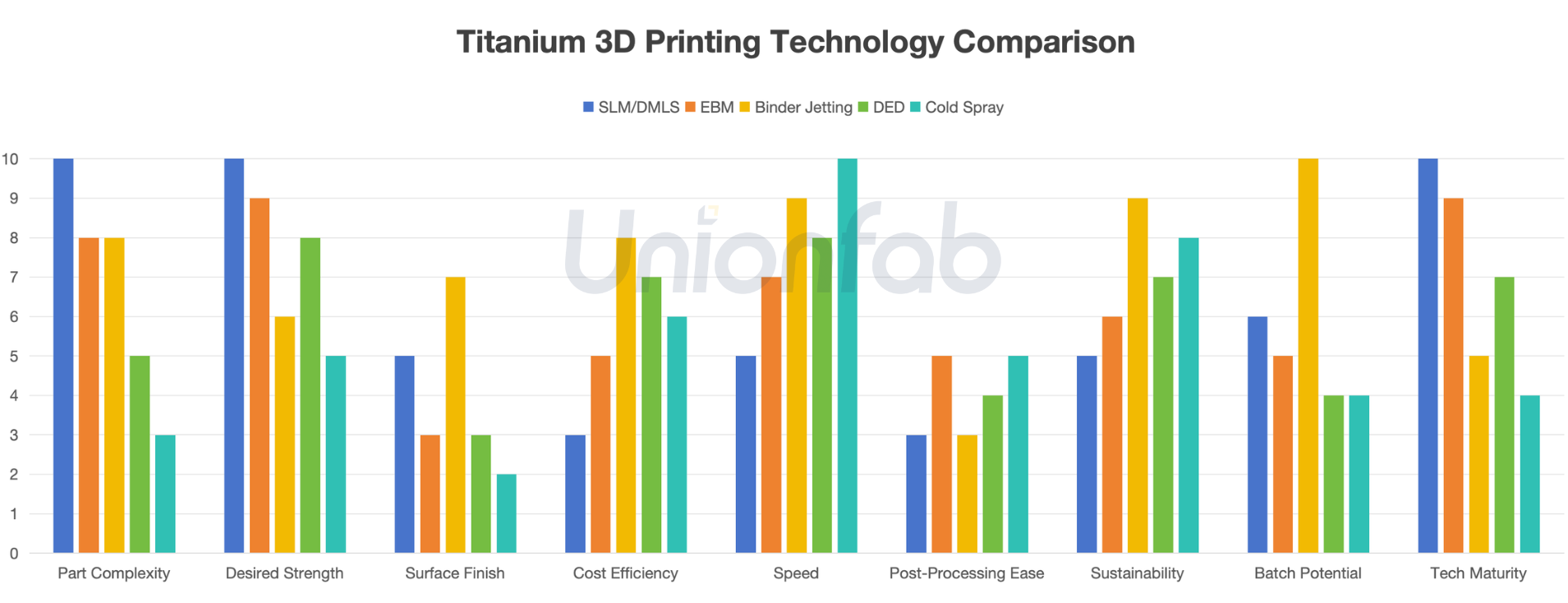
The bar chart below compares how different technologies perform when processing titanium across key performance criteria, helping you identify the most suitable technology for your application.
Key Takeaways
-
SLM/DMLS: Best for high-precision, complex geometries. It is the industry standard for medical implants and intricate aerospace brackets. However, parts require stress-relief heat treatment and Hot Isostatic Pressing (HIP) to eliminate high internal stresses and micro-porosity.
-
EBM: Best for fatigue-critical aerospace structures. The vacuum, high-heat build environment (> 700°C) prevents oxidation and eliminates residual stress, though the surface is coarser and requires “decaking.”
-
Binder Jetting: Best for high-volume, cost-sensitive production. Ideal for mass-producing small industrial parts, provided that the application can tolerate the chemical impurities (carbon/oxygen) typical of the sintering process.
-
DED: Best for large-scale structural repairs and near-net shapes. Perfect for massive aircraft components where speed is prioritized over detail; requires aggressive argon shielding to manage titanium’s reactivity.
-
Cold Spray: Best for thermal-sensitive repairs and coatings. Since the titanium never melts, this process completely avoids oxidation and thermal distortion, making it a unique tool for restoring high-value components.
Titanium 3D Printers: Common Machines and Typical Costs
The market for titanium-capable 3D printers offers a variety of solutions tailored to different production scales and precision requirements. The following table highlights the most common machines, their core technologies, and the typical investment required for a full system.
|
3D Printer Model |
Manufacturer |
Printing Technology |
Build Volume |
Approximate Price (System) |
Notable Features |
|---|---|---|---|---|---|
|
Markforged Metal X |
Markforged |
Atomic Diffusion Additive Manufacturing (ADAM) |
300 x 220 x 180 mm |
$150,000 – $250,000 |
Accessible entry-level; requires specialized sintering furnace. |
|
EOS M 290 |
EOS GmbH |
Direct Metal Laser Sintering (DMLS) |
250 x 250 x 325 mm |
$750,000 – $900,000 |
The “Gold Standard” for industrial titanium reliability. |
|
GE Arcam EBM Q10plus |
GE Additive |
Electron Beam Melting (EBM) |
200 x 200 x 180 mm |
$700,000 – $900,000 |
Best for medical implants; vacuum prevents titanium oxidation. |
|
SLM Solutions SLM 500 |
SLM Solutions |
Selective Laser Melting (SLM) |
500 x 280 x 365 mm |
$1,200,000 – $1,600,000 |
Quad-laser system; pioneer in large-format titanium production. |
|
Renishaw RenAM 500Q |
Renishaw |
Laser Powder Bed Fusion (LPBF) |
250 x 250 x 350 mm |
$1,000,000 – $1,200,000 |
High-productivity quad-laser with intelligent gas flow control. |
|
SLM Solutions SLM 280 2.0 |
SLM Solutions |
Selective Laser Melting (SLM) |
280 x 280 x 365 mm |
$600,000 – $800,000 |
Robust dual-laser system; highly flexible for various titanium powders. |
Cost Breakdown of Titanium 3D Printing Services
Understanding the titanium 3D printing service cost is essential for budgeting high-performance engineering projects. The total price you pay is not just for the material; it is a combination of several technical and logistical factors.
You can calculate the final amount using this formula:
Total Cost = Printing Cost (material price × part weight) + Post-Processing Cost + Packaging Fees + Shipping Fees + Customs Duty
Now, let’s take a closer look at each of these components:
1. Printing Cost
The printing cost usually accounts for the largest portion of the titanium 3D printing price. It is mainly determined by two factors:
Titanium Material Price
-
Titanium powder for 3D printing price: typically ranges from $250 to $600 per kg.
-
The cost of titanium powder for 3D printing varies based on the alloy (e.g., Ti-6Al-4V Grade 5 vs. Grade 23), particle size distribution, and your total purchase volume.
Part Weight
Part Weight = Model Volume × Material Density
Titanium alloys have an average density of ~4.43 g/cm³. Larger or more solid parts directly increase material consumption and, therefore, cost.
Example Calculation:
-
Model Volume: 10 cm³
-
Titanium Density: 4.43 g/cm³
-
Titanium powder price: $0.45/g
-
Printing Cost = 10 × 4.43 × 0.45 = $19.94
*Note: This is a simplified example. Actual titanium 3D printing service cost may vary based on order volume and machine utilization. In most cases, batch production reduces the cost per part.
2. Post-Processing Cost
Titanium 3D printed parts are typically not ready for end use directly after printing. For most industrial and functional applications, titanium alloys require post-processing to meet mechanical, dimensional, and surface quality requirements.
Typical Post-Processing for Titanium Alloys (e.g., Ti-6Al-4V)
In practical applications, post-processing commonly includes:
-
HIP (Hot Isostatic Pressing) Improves density and fatigue performance by reducing internal porosity.
-
Heat Treatment Relieves residual stress and stabilizes mechanical properties.
-
Surface Finishing Such as CNC machining for tolerances, or bead blasting for surface uniformity.
In practice:
Titanium alloys and nickel-based alloys are often processed with HIP and heat treatment first, followed by machining or surface finishing, depending on application requirements.
How Post-Processing Costs Are Calculated
Post-processing costs are usually based on:
-
Post-Processing Method HIP and heat treatment are higher-cost processes due to specialized equipment and long cycle times.
-
Part Size and Weight Larger or heavier parts increase HIP and heat treatment costs.
-
Geometry and Tolerance Requirements Complex features and tight tolerances increase machining time.
-
Quantity Single parts have higher per-unit costs, while batch production reduces the cost per part.
For a more detailed explanation of 3D printing post-processing methods and how they are priced, refer to our guide on 3D printing post-processing.
3. Packaging Fees
Packaging is often overlooked, but it matters—especially for dense titanium parts.
-
Standard packaging (Free): Corrugated boxes with foam or bubble wrap for small parts
-
Protective packaging (Paid): Required for heavy, large, or high-value titanium components
Typical paid costs:
-
Wooden crates:
-
Small–medium parts: $50–$300
-
Large or reinforced crates: $500+
-
-
Custom flight cases:
-
Small parts: $200–$500
-
Large or precision parts: $800–$2,000+
-
4. Shipping Fees
Shipping costs depend on:
-
Part weight and dimensions
-
Destination (domestic vs. international)
-
Shipping speed (standard vs. express)
-
Carrier (DHL, FedEx, UPS, etc.)
Because titanium parts are dense, shipping fees can noticeably impact the total cost, especially for international orders.
5. Customs Duty
For cross-border shipments, customs duties may apply based on local regulations.
-
Typical customs duty range: 5%–20% of the declared product value
-
Rate depends on destination country and HS code classification
This cost is usually paid by the buyer and should be considered when estimating the final service price.
To better understand the full cost structure of metal 3D printing and how each component contributes to the final price, see our guide on metal 3D printing cost.
Challenges of 3D Printing with Titanium
While 3D printing with titanium offers incredible advantages, it also comes with several challenges that need careful consideration:
Titanium Supply Chain & Pricing
Titanium powder is notoriously expensive, and its supply can be volatile. Fluctuating prices, limited suppliers, and complex procurement processes add to the financial burden.
For businesses, managing titanium’s supply chain and sourcing quality powder at a competitive price can be a significant challenge, especially for high-volume production.
Furthermore, high upfront and ongoing costs for specialized EBM/SLM machines and post-processing steps make titanium 3D printing impractical for smaller businesses.
Safe Handling
Titanium powder is highly flammable, making safety a major concern during 3D printing. To prevent fire hazards, printing must take place in an inert gas environment (such as argon or nitrogen).
This adds complexity, as specialized equipment is needed to maintain an oxygen-free atmosphere and meet strict safety protocols.
Real-World Titanium 3D Printing Case Studies from Unionfab
Titanium 3D printing is no longer a theoretical solution; it is being used to push the boundaries of weight reduction and fluid dynamics.
Below are two case studies from Unionfab that demonstrate the versatility of the technology.
Case Study 1: Unionfab’s 3D-Printed Titanium Electronic Cooling Housing
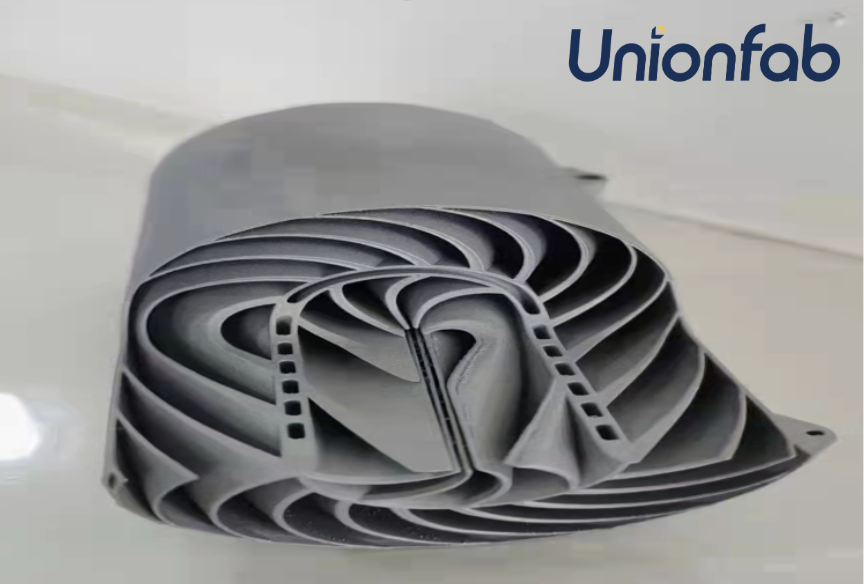
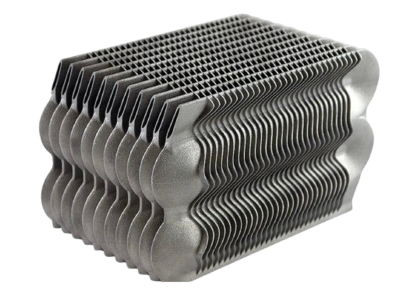
Using SLM 3D printing and TC4 titanium alloy, Unionfab manufactured a high-performance electronic cooling housing with complex internal geometries. This project demonstrates how titanium 3D printing can integrate advanced thermal management into a single, lightweight component.
-
Integrated Cooling Manifold: The housing features an intricate, curved internal flow structure. This design optimizes fluid dynamics and heat dissipation paths, which would be impossible to achieve using traditional CNC drilling or casting.
-
Key Design Features:
-
Monolithic Construction: By consolidating multiple cooling components into a single 3D-printed part, Unionfab eliminated the need for assembly and significantly reduced potential leak points.
-
Lightweight Structural Integrity: Leveraging titanium’s high strength-to-weight ratio, the housing provides robust protection for sensitive electronics while maintaining a minimal weight profile.
-
Material Efficiency: The near-net-shape production process minimized the waste of expensive titanium alloy, achieving a superior “buy-to-fly” ratio compared to subtractive manufacturing.
-
-
Surface Treatment: The part underwent specialized sandblasting to ensure a uniform finish, enhancing both the aesthetic quality and the fatigue resistance of the cooling channels.